Faith, Dirty Grace, and a Whole Lotta Whiskey, Regret, and Resurrection.
Visit my domain to dive face-first into the wild ride of my brain — a mashup of raw truths, dirty jokes, mental fistfights, and midnight rambles you didn’t know you needed.
Saint Dirty Face. Imperfect on purpose. Faithful with fangs. Here to spill it all, laugh at the absurd, and maybe light a match under your too-comfortable chair.
Gratitude doesn’t require lying about the year you survived.
Thanksgiving has a strange way of turning every family into a temporary public-relations department.
Everyone gathers.
Food appears.
Somebody takes a photograph before the arguments begin.
And for a few hours, we are expected to behave as though every relationship is healthy, every chair is filled, and nobody has been quietly avoiding Uncle What’s-His-Name since the incident nobody discusses.
Family gatherings can be beautiful.
They can also become hostage situations with pie.
Both things may be true.
You can love your family and still need boundaries.
You can miss someone who hurt you.
You can forgive without reopening the door.
You can be grateful for the people at the table while feeling the weight of the person who is no longer sitting there.
That isn’t ingratitude.
That’s being human.
Some years arrive carrying promotions, weddings, new babies, restored health, and prayers answered exactly as requested.
Other years kick the door open, eat everything in the refrigerator, and leave you rebuilding your life with three functioning screws and a questionable amount of profanity.
You don’t have to call that beautiful.
You don’t have to pretend every wound was secretly a gift.
And you definitely don’t have to explain your grief to someone who thinks discomfort can be cured by passing the mashed potatoes.
Gratitude is not denial.
It is noticing what remained without pretending nothing was lost.
The person who stayed.
The body that kept carrying you.
The stranger who helped.
The laughter that returned unexpectedly.
The bill you somehow paid.
The prayer that wasn’t answered the way you wanted—but kept you from becoming someone you wouldn’t recognize.
Faith doesn’t ask us to manufacture happiness for the holiday photograph.
Even Jesus wept.
He became tired.
He withdrew from crowds.
He broke bread with imperfect people—and somehow managed without requiring everyone to coordinate matching outfits.
There’s room at the table for honesty.
But boundaries don’t excuse bad behavior either.
Don’t arrive looking for a fight and call it authenticity.
Don’t use “protecting my peace” as permission to punish everybody else.
Apologize when you owe one.
Help with the dishes.
Listen to the story you’ve heard twelve times.
And if somebody is genuinely trying, don’t make them pay forever for the version of themselves they’re working to leave behind.
That’s grace.
Not amnesia.
Not unlimited access.
Grace with a functioning memory and enough self-respect to know the difference.
So this week, give thanks without performing.
Laugh loudly.
Step outside when you need air.
Remember the missing.
Feed whoever came hungry.
Forgive what can be forgiven.
Leave what must remain behind.
And if the gathering becomes unbearable, remember:
Dessert travels.
You don’t have to pretend everything was good.
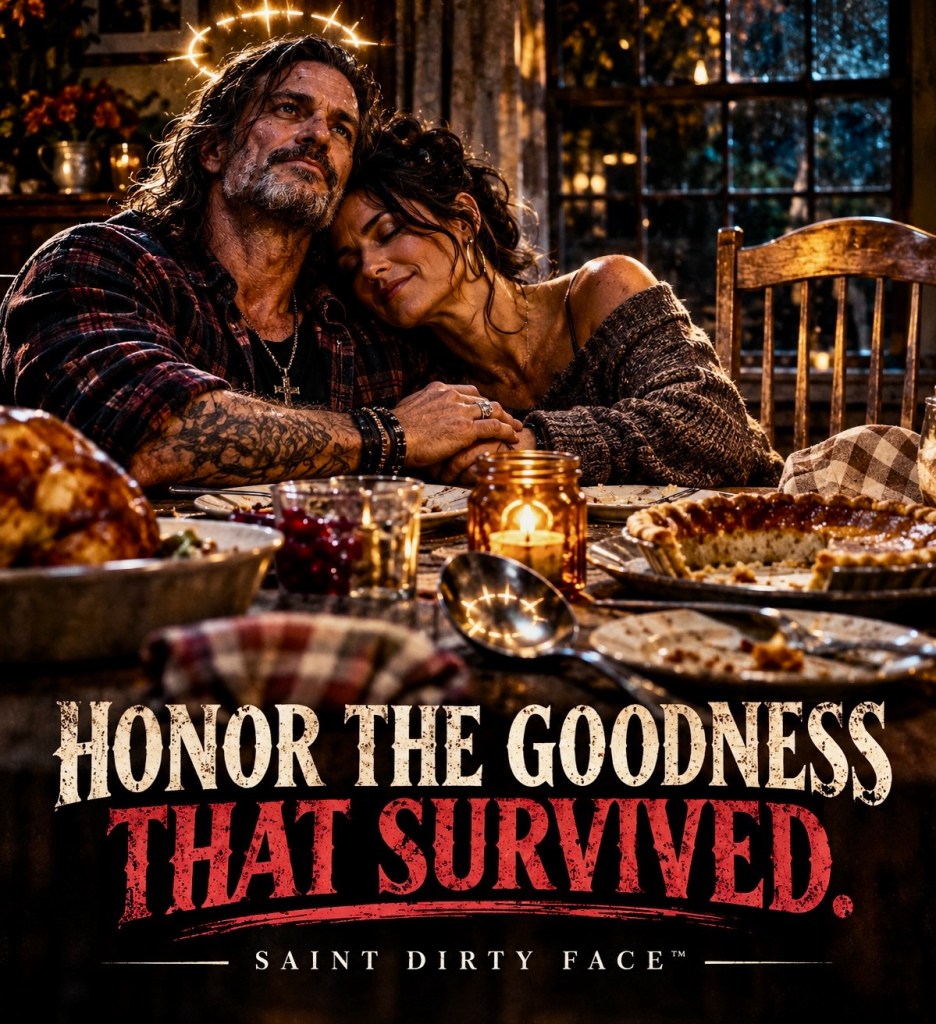
Just honor whatever goodness survived.
— SAINT DIRTY FACE™ Imperfect on Purpose. Faithful with Fangs.
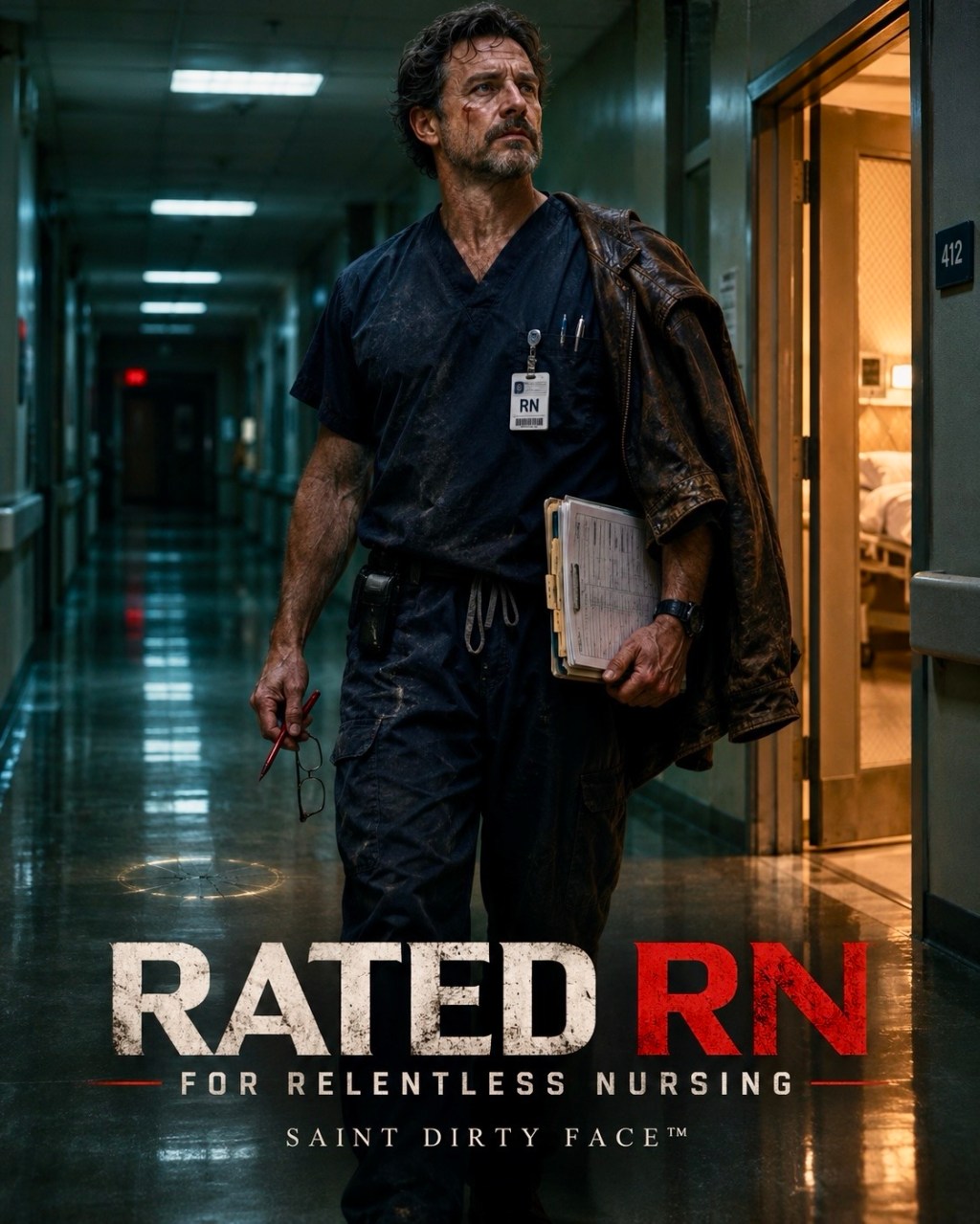
Thirty-two years in nursing taught me that experience isn’t knowing everything—it’s recognizing what doesn’t look right and having the nerve to ask again.
Competence rarely enters the room dramatically.
It checks the chart.
Notices the missing medication.
Questions the discharge plan.
Looks at the patient instead of only the monitor.
And asks why everybody keeps documenting “stable” when the human being in the bed clearly looks like hell.
Sometimes clinical intuition is thirty-two years of pattern recognition wearing comfortable shoes.
You learn which silence means sleep and which one means trouble.
Which family member has an important piece of the story.
Which patient says “I’m okay” because they don’t want to bother anyone.
Which administrator’s “quick question” is about to consume the next forty-five minutes of your life.
You also develop a highly specialized professional skill:
Smelling a bad discharge plan from three hallways away.
Relentless nursing isn’t about playing hero.
Healthcare already has enough people confusing titles, degrees, and expensive name badges with character.
It isn’t about martyrdom either.
Working until you collapse is not evidence of dedication.
Sometimes it is evidence that a broken system discovered you would keep compensating for it.
Relentless means you stay with the problem.
You verify.
You document.
You call again.
You escalate when necessary.
You explain the medication one more time without making the patient feel stupid.
You tell the physician what changed.
You tell the family what matters.
And when something is beyond your authority, you don’t pretend otherwise—you find the person who can act.
Compassion without competence is sentiment.
Competence without compassion is machinery.
Patients deserve both.
They deserve a nurse who can hold a frightened hand and still challenge an unsafe order.
A nurse who understands that advocacy is not aggression.
That boundaries are not abandonment.
That saying “This is not safe” is sometimes the most caring sentence spoken all day.
Nursing taught me that people rarely remember every clinical detail.
They remember whether you believed them.
Whether you explained what was happening.
Whether you came back when you said you would.
Whether you treated them like a person after illness had reduced their world to gowns, numbers, tubes, and strangers discussing them in the hallway.
Faith lives there too.
Not in pretending we can save everyone.
We can’t.
That truth leaves scars.
Faith lives in serving the person in front of us without demanding that the outcome prove our effort mattered.
Sometimes healing happens.
Sometimes comfort is the work.
Sometimes the victory is getting one stubborn insurance representative to stop reading the script and actually listen.
The battlefield changes.
Hospital floor.
Public-health clinic.
Leadership office.
Patient advocacy from a desk at home.
But the mission stays recognizable:
See the person.
Find the problem.
Protect what matters.
Finish what you can.
And leave enough light for whoever comes next.
I’m not a hero.
I’m a nurse who learned not to walk past the loose end.
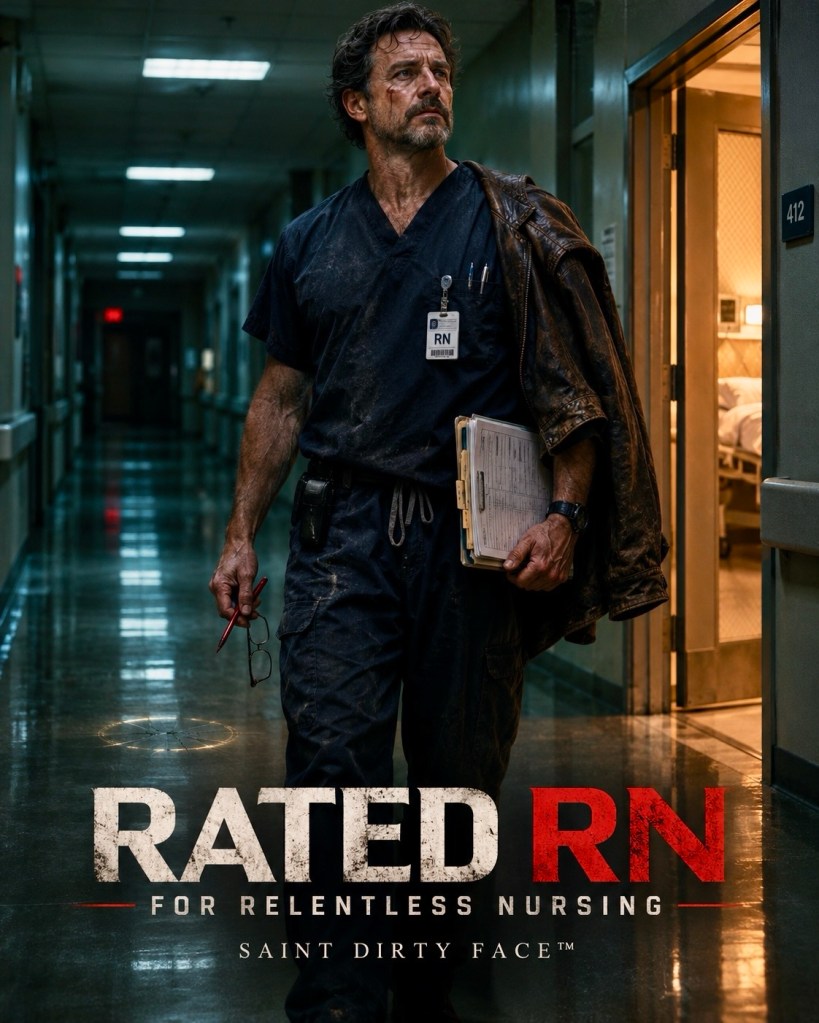
Rated RN for Relentless Nursing.
— SAINT DIRTY FACE™ Imperfect on Purpose. Faithful with Fangs.
Power Ballads, Bad Decisions, and the Lost Art of Being Gen X
By Saint Dirty Face™
There was a time when men wore leather jackets, women wore enough hairspray to violate international environmental treaties, and love came with a guitar solo.
We didn’t have Spotify.
We didn’t have dating apps.
We had cassette tapes, questionable judgment, and enough confidence to believe that eleven carefully selected love songs could change somebody’s life.
Sometimes they did.
Sometimes they just got us into trouble.
Either way, we had one hell of a soundtrack.
A Plethora, El Jefe!
If you grew up in the ‘80s, you learned some of life’s most important lessons from movies that would probably send today’s internet into cardiac arrest.
Blazing Saddles.
Spaceballs.
History of the World, Part I.
Three Amigos!
Mel Brooks taught us that comedy could challenge almost anything.
Richard Pryor and Eddie Murphy taught us that laughter didn’t always have to be polite.
And Harlem Nights taught us that getting shot in the pinky toe could lead to a very unpleasant evening.
We quoted these movies until our friends begged us to stop.
Then we quoted them again.
Because when someone mentions a plethora, every properly educated Gen Xer knows there’s a joke coming.
And we still laugh.
Forty years later.
The Women Who Ruined Our Concentration
Vanity.
Apollonia.
Kelly LeBrock.
Phoebe Cates.
Lord have mercy.
The ‘80s weren’t just a decade. They were an assault on the adolescent nervous system.
Vanity brought dangerous glamour to The Last Dragon. And her real-life relationship with Mötley Crüe’s Nikki Sixx connected two worlds of ‘80s excess: Prince’s musical universe and the Sunset Strip.
Apollonia walked into Purple Rain and made an entire generation forget what they were supposed to be doing.
Kelly LeBrock in Weird Science?
Forget artificial intelligence. Those two boys had bigger technological ambitions than Silicon Valley.
And Phoebe Cates in Fast Times at Ridgemont High?
Let’s just say a generation of teenage boys suddenly developed a powerful appreciation for swimming pools.
We were young.
We were impressionable.
And subtlety was not exactly Hollywood’s strongest selling point.
We Were Almost Famous
Music wasn’t something we listened to.
It was something we lived inside.
Almost Famous captured that feeling beautifully.
The backstage passes. The tour buses. The musicians who were simultaneously brilliant, ridiculous, and one bad decision away from disaster.
The feeling that somewhere beyond the next highway exit, something extraordinary was waiting.
Then there was Crossroads.
One minute, Ralph Macchio was chasing the blues.
The next, Steve Vai appeared with a guitar and made us question everything we thought we knew about six strings.
That movie could send you straight into a lifelong appreciation of blues and guitar virtuosity.
From Muddy Waters and Howlin’ Wolf to B.B. King and Stevie Ray Vaughan.
And from Steve Vai to David Lee Roth and eventually Whitesnake.
That was the beauty of the era.
One movie.
One guitar solo.
One song.
And suddenly you had a new obsession.
The Sacred Art of the Mixtape
Now let’s discuss something that deserves its own place in the Smithsonian.
The romantic mixtape.
Young people today will never understand the pressure.
You couldn’t just drag songs into a playlist.
You sat beside the radio with your finger hovering over RECORD, praying the DJ would shut his damn mouth before the first guitar riff.
You calculated tape length.
You arranged the songs.
You wrote the titles by hand.
And if the cassette ran out halfway through the perfect love ballad?
Brother, you started over.
Because a mixtape wasn’t background music.
It was a love letter written in magnetic tape.
And song order mattered.
You didn’t just throw eleven tracks together and hope for the best.
You built a journey.
You opened with the Scorpions.
Still Loving You.
Then Journey.
Faithfully.
Steve Perry reminding everybody that even rock-and-roll troublemakers occasionally understood commitment.
Then Foreigner.
I Want to Know What Love Is.
By this point, the emotional defenses were beginning to crumble.
Whitesnake followed.
Is This Love.
David Coverdale making a compelling argument for dimming the lights.
Then came REO Speedwagon, Chicago, Bryan Adams, Bon Jovi, Cinderella, and Def Leppard.
Ten songs.
Ten emotional haymakers.
A musical declaration of love, longing, heartbreak, and everything in between.
And just when you thought the evening had reached its natural conclusion…
The Nuclear Option
Michael Bolton.
When a Man Loves a Woman.
Yes, his version came out in 1991.
We didn’t care.
The ‘80s didn’t end neatly on December 31, 1989. They lingered in our cars, our cassette decks, and our questionable romantic decisions.
Bolton came roaring through the speakers like a man who had just discovered that love was simultaneously the greatest gift and the most expensive emotional liability known to mankind.
And that was it.
The final song.
The last dance.
The grand romantic declaration.
Eleven songs.
One carefully constructed emotional masterpiece.
Surely, nothing could possibly ruin that moment.
Right?
Hail to the King, Baby
Picture the scene.
The final note fades.
The room falls quiet.
Our hero retrieves his leather jacket.
He walks toward the door.
Stops.
Turns around.
Smiles.
And delivers the immortal wisdom of Ash Williams from Army of Darkness.
“It was just pillow talk, baby.”
CUT TO BLACK.
ROLL CREDITS.
Somewhere, a chainsaw starts.
Because nothing says romance quite like ending your carefully constructed love story with a Bruce Campbell punchline.
And that’s what made our generation different.
We could spend an entire evening listening to love ballads, quoting romantic lyrics, and pretending to be sophisticated gentlemen.
Then immediately ruin the moment with a smart-ass movie reference.
And somehow, that made it better.
We Were Ridiculous. And We Were Alive.
We were romantic.
We were rebellious.
We were sarcastic.
We made terrible fashion choices and occasionally worse decisions.
But we felt everything.
The music mattered.
The movies mattered.
The memories mattered.
And somewhere between the laughter, the guitar solos, the ridiculous one-liners, and those homemade cassette tapes, we learned how to be human.
Not perfect.
Not polished.
Just human.
Maybe that’s what I miss most.
Not the hairstyles.
Not the parachute pants.
Not even the Camaros.
I miss when giving somebody a collection of songs meant you’d spent hours trying to say something you couldn’t quite put into words.
When music could stop an argument, start a romance, or remind you of somebody you hadn’t seen in forty years.
When you could laugh at yourself without apologizing for having a sense of humor.
When being a little foolish wasn’t something to hide.
Because sometimes the foolish things become the memories worth keeping.
We have more information than any generation in history—and half the time we’re still taking advice from a screenshot posted by somebody with a skull avatar.
The modern world doesn’t have an information shortage.
It has a signal problem.
Everything arrives screaming.
Breaking.
Urgent.
Shocking.
The thing they don’t want you to know—usually brought to you by someone desperately hoping you won’t ask how they know it.
We used to have three television channels, a busy signal, and one family encyclopedia missing the volume containing whatever the hell we actually needed.
Now the combined knowledge of humanity lives in our pockets.
Naturally, we use it to argue with strangers and watch raccoons steal cat food.
Progress.
But all that noise comes at a cost.
When everything demands a reaction, reflection starts feeling irresponsible.
When every disagreement becomes an emergency, we stop distinguishing discomfort from danger.
When repetition is mistaken for truth, the loudest lie gets promoted to common knowledge.
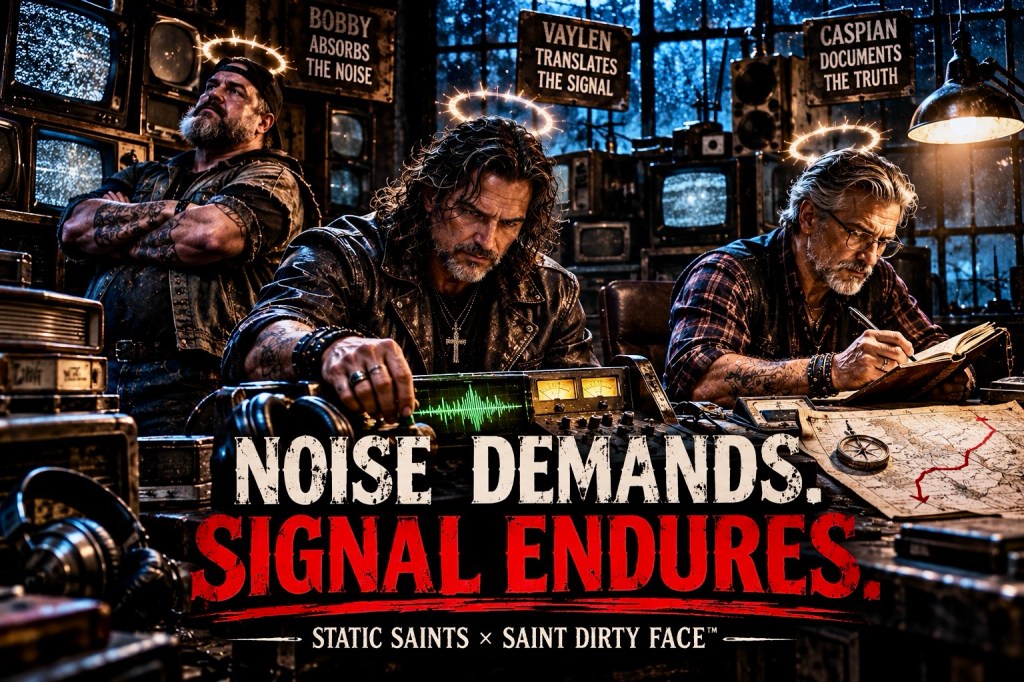
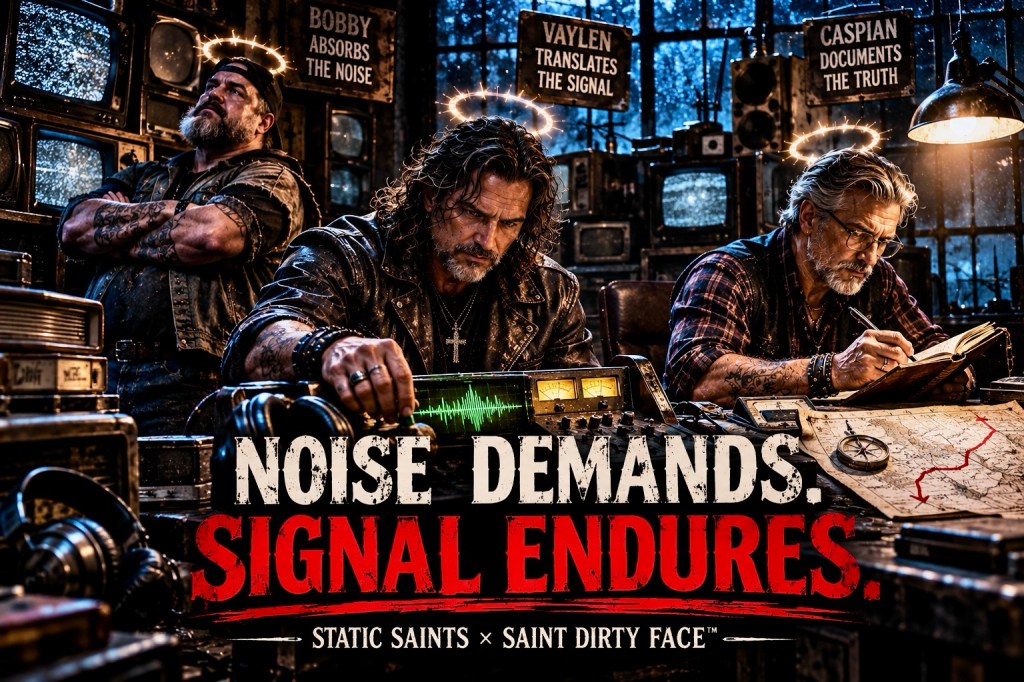
That’s where the Static Saints work begins.
Bobby absorbs the white noise through lived experience.
Not theories.
Not slogans.
The actual human cost beneath them.
Vaylen takes what Bobby carries and separates volume from meaning.
He asks the questions noise hates:
Is it true?
Who benefits from my reaction?
What is missing?
What remains when the anger wears off?
Caspian documents what survives.
Not every opinion.
Not every outrage.
Only the signal worth preserving—so when the noise moves on to its next victim, somebody still remembers what happened.
That isn’t cynicism.
It’s discernment.
Because urgency is not evidence.
Confidence is not competence.
Popularity is not character.
And silence is not automatically wisdom either.
Sometimes silence is cowardice dressed as composure.
Sometimes the truth needs to be spoken clearly, verified carefully, and defended without turning into the very noise it came to correct.
Faith works much the same way.
I’ve rarely found meaning in the people shouting that they alone possess it.
The sacred usually arrives quieter.
A conscience you can’t bargain with.
A hand extended when nobody is filming.
The uncomfortable realization that you might be wrong.
A voice reminding you that truth without compassion becomes another weapon—and compassion without truth becomes permission.
So slow down.
Listen longer.
Verify before repeating.
And don’t surrender your nervous system to everyone demanding immediate access to it.
Noise demands your reaction.
Signal earns your attention.
— THE STATIC SAINTS Bobby absorbs it. Vaylen translates it. Caspian makes sure it doesn’t vanish
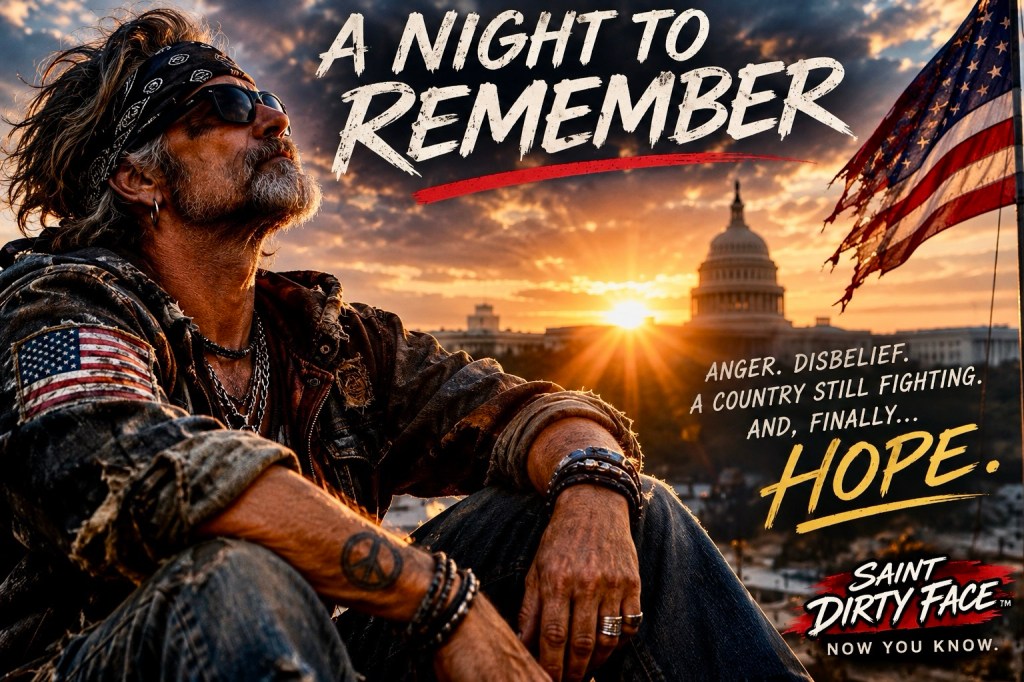
There’s a hell of a lot to unpack after these midterms. Anger. Frustration. Disbelief. And something I wasn’t entirely sure I’d feel again anytime soon.
Hope.
Yeah. That one caught me off guard.
Before we go any further, let’s get something out of the way.
I’m a Democrat.
There. No mystery. No clever disguise. No pretending to be something I’m not just to make somebody comfortable.
I’m not perfect. Never claimed to be. I’ve got my opinions, my flaws, and enough years behind me to know I haven’t always gotten everything right.
But I try.
These are my thoughts. My words. My little corner of the world where I get to say what’s on my mind.
You don’t have to agree with me.
Hell, that’s part of the beauty of living in a free country.
Now, let’s talk about tonight.
Waiting for the Other Shoe to Drop
I went into election night skeptical as hell.
Because how many times have we seen this movie?
The early numbers start rolling in. A little blue here. A little hope there. You start thinking maybe, just maybe, something is changing.
Then the night gets longer.
The map starts turning red.
And there goes that familiar feeling of disappointment.
Same movie. Different election.
So I sat there watching the results, trying not to get my hopes up.
Because after a while, disappointment teaches you to keep your expectations low.
But something felt different.
As the races came in and the political landscape began taking shape, I found myself leaning forward instead of shaking my head.
Could this really be happening?
Could people actually be saying they’ve had enough?
I kept waiting for the other shoe to drop.
And for once, I started wondering whether it actually would.
Let’s Talk About Why People Are Angry
I’m angry.
And not because somebody votes differently than I do.
I’ve been around long enough to know that good people can disagree about politics, shake hands afterward, and still respect each other.
What angers me is watching the country I grew up believing in become a place I sometimes struggle to recognize.
I look at our foreign policy and wonder when diplomacy started taking a back seat to displays of power.
I look at immigration enforcement and wonder whether we’ve forgotten that protecting our borders and respecting human dignity should never be mutually exclusive.
I look at our relationships with longtime allies and neighbors and wonder why cooperation has become something politicians treat like weakness.
I look at the institutions and traditions that once represented stability, accountability, and national pride, and I wonder how much more division they’re expected to withstand.
And then I look at ordinary Americans.
People getting up before sunrise, working their asses off, raising families, caring for aging parents, and trying to stretch a paycheck that doesn’t seem to stretch nearly as far anymore.
People who aren’t asking for mansions, yachts, or private jets.
Just a decent life.
A little breathing room.
A future their children can actually look forward to.
And somewhere in all this noise, I keep coming back to one question.
Who the hell are we doing all this for?
Because government shouldn’t exist to serve egos, reward loyalty, or make the powerful even more powerful.
It should serve the people.
All the people.
Not just the ones who voted for the winning side.
And here’s where I’ll probably surprise a few people.
I don’t believe every Republican is the enemy. I don’t believe every Democrat is the answer.
I’ve seen enough of life to know that putting a letter beside somebody’s name doesn’t automatically make them honorable, competent, or worth trusting.
Character matters.
Accountability matters.
Human decency matters.
And when those things start disappearing from our leadership, we have every right to be angry.
But anger alone doesn’t rebuild anything.
It has to become something useful.
A conversation. A demand for accountability. A willingness to listen.
And when the time comes, a vote.
Because loving your country doesn’t mean pretending everything is fine. Sometimes it means having the guts to say it isn’t.
Well, Look Who Woke Up
And then the election results started coming in.
Races tightening. Longtime political loyalties being challenged. Voters making their dissatisfaction known.
And I sat there watching.
Waiting.
Could this really be happening?
There’s a word politicians and commentators love throwing around.
Woke.
Usually like it’s some kind of insult.
Well, here’s a thought.
Maybe people are waking up to the bullshit.
Maybe they’re tired of being divided, manipulated, frightened, and told to hate their neighbors.
Maybe they’re tired of being treated like idiots.
And maybe, just maybe, they’re remembering that they still have a voice.
Here’s the part I love.
We don’t need violence to prove it.
We don’t need to burn down our neighborhoods.
We don’t need to threaten somebody because they voted differently.
We have something far more powerful.
A ballot.
One person. One vote. A voice that belongs to the voter, not the politician.
That’s how you challenge power in a democracy.
You show up.
You vote.
And you make the people in office answer for what they’ve done.
Don’t Mistake Hope for a Miracle
Now, before somebody thinks I’ve suddenly turned into a wide-eyed optimist, let me clear something up.
I’m Gen X.
We grew up being told to figure it out, shake it off, and keep moving.
We learned early that the world doesn’t hand out happy endings just because you deserve one.
So no, I don’t think one election fixes everything.
Not even close.
The damage I see in our institutions, our relationships, our public trust, and our national reputation didn’t happen overnight.
And it won’t disappear overnight either.
There will be political fights. Broken promises. Disappointments. Probably more than a few moments when I’ll want to throw the remote across the living room.
But tonight reminded me of something.
The country isn’t finished.
There’s still a pulse.
There’s still fight.
There’s still a chance to turn this thing around.
And to the rest of the world watching us stumble through our own mess, I’d like to say something.
Don’t give up on America just yet.
Some of us are still here.
Some of us still give a damn.
Democracy Was Never About Worshipping Politicians
Here’s something that apparently needs repeating.
Democracy isn’t a politician.
It isn’t a political party.
It isn’t a red hat, a blue sign, a campaign slogan, or some loudmouth on television telling you who to hate.
Democracy is the people.
It’s the right to choose who governs us.
It’s the right to question them.
To criticize them.
To demand accountability.
And when they fail to represent us, to vote them out.
That’s the deal.
No kings.
No political royalty.
No elected official above the people they’re supposed to serve.
And no political party gets a lifetime subscription to our loyalty.
Loyalty to your country should never require blind loyalty to its leaders.
That’s not patriotism.
That’s surrender.
And I don’t know about you, but I wasn’t raised to surrender my voice.
The Hard Part Starts Tomorrow
So here we are.
One hell of an election night.
A little disbelief.
A little satisfaction.
And for the first time in a while, a little light coming through the cracks.
But let’s not confuse winning elections with fixing a country.
The real work starts when the campaign signs come down.
When the speeches stop.
When the cameras leave.
That’s when the people we elected have to earn the trust we placed in them.
And that’s when we have to keep paying attention.
Because democracy isn’t something you dust off every two or four years and then shove back into the closet.
It’s a responsibility.
An ongoing one.
We have a long road ahead of us. There’s no magic reset button, no quick fix, and no guarantee that the people we put in office won’t disappoint us.
But tonight gave me a reason to believe that the road is still worth traveling.
Together.
Democrats. Republicans. Independents. And everybody who’s sick of being told they have to hate somebody to love their country.
We don’t have to agree on everything.
We just have to remember that this country belongs to all of us.
And tonight?
For a moment, I felt like the people remembered that.
I started this evening angry. Sad. Frustrated. Wondering what the hell happened to the country I love.
I’m not going to pretend all those feelings disappeared.
They didn’t.
But something else showed up tonight.
Something I hadn’t realized how badly I’d missed.
Hope.
Not the kind politicians sell you in thirty-second commercials.
The kind that sneaks up on you when you’ve almost convinced yourself there’s nothing left to believe in.