Power Ballads, Bad Decisions, and the Lost Art of Being Gen X
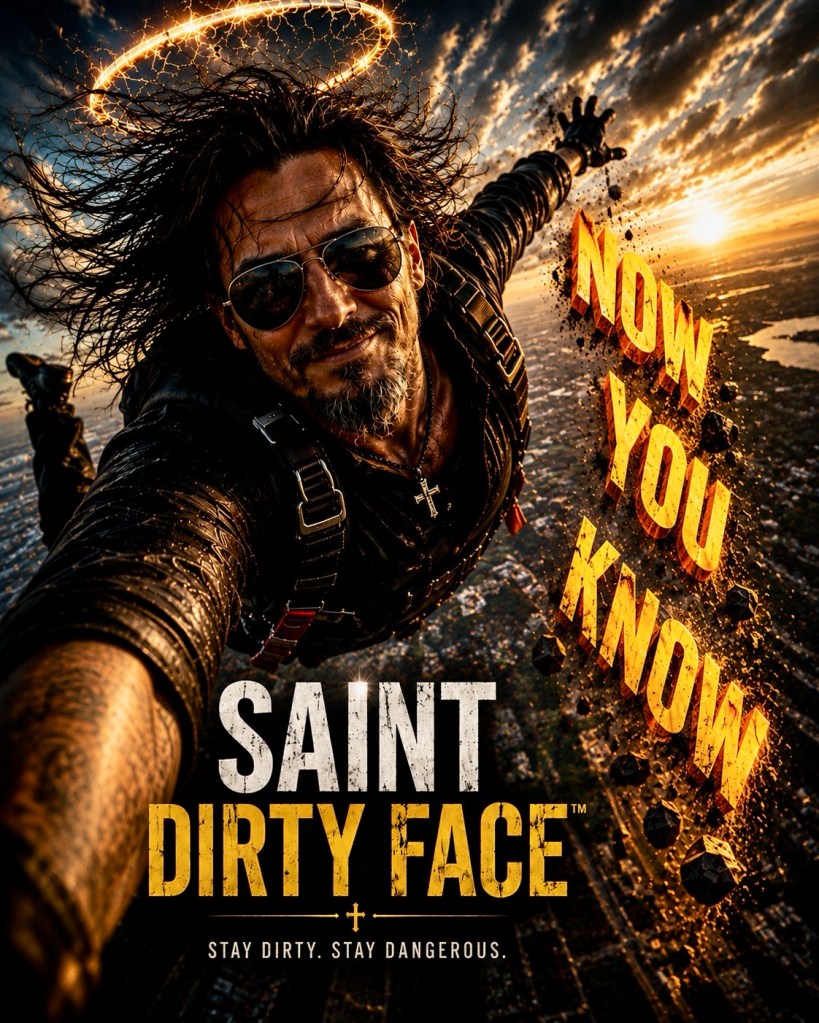
By Saint Dirty Face™
There was a time when men wore leather jackets, women wore enough hairspray to violate international environmental treaties, and love came with a guitar solo.
We didn’t have Spotify.
We didn’t have dating apps.
We had cassette tapes, questionable judgment, and enough confidence to believe that eleven carefully selected love songs could change somebody’s life.
Sometimes they did.
Sometimes they just got us into trouble.
Either way, we had one hell of a soundtrack.
A Plethora, El Jefe!
If you grew up in the ‘80s, you learned some of life’s most important lessons from movies that would probably send today’s internet into cardiac arrest.
Blazing Saddles.
Spaceballs.
History of the World, Part I.
Three Amigos!
Mel Brooks taught us that comedy could challenge almost anything.
Richard Pryor and Eddie Murphy taught us that laughter didn’t always have to be polite.
And Harlem Nights taught us that getting shot in the pinky toe could lead to a very unpleasant evening.
We quoted these movies until our friends begged us to stop.
Then we quoted them again.
Because when someone mentions a plethora, every properly educated Gen Xer knows there’s a joke coming.
And we still laugh.
Forty years later.
The Women Who Ruined Our Concentration
Vanity.
Apollonia.
Kelly LeBrock.
Phoebe Cates.
Lord have mercy.
The ‘80s weren’t just a decade. They were an assault on the adolescent nervous system.
Vanity brought dangerous glamour to The Last Dragon. And her real-life relationship with Mötley Crüe’s Nikki Sixx connected two worlds of ‘80s excess: Prince’s musical universe and the Sunset Strip.
Apollonia walked into Purple Rain and made an entire generation forget what they were supposed to be doing.
Kelly LeBrock in Weird Science?
Forget artificial intelligence. Those two boys had bigger technological ambitions than Silicon Valley.
And Phoebe Cates in Fast Times at Ridgemont High?
Let’s just say a generation of teenage boys suddenly developed a powerful appreciation for swimming pools.
We were young.
We were impressionable.
And subtlety was not exactly Hollywood’s strongest selling point.
We Were Almost Famous
Music wasn’t something we listened to.
It was something we lived inside.
Almost Famous captured that feeling beautifully.
The backstage passes. The tour buses. The musicians who were simultaneously brilliant, ridiculous, and one bad decision away from disaster.
The feeling that somewhere beyond the next highway exit, something extraordinary was waiting.
Then there was Crossroads.
One minute, Ralph Macchio was chasing the blues.
The next, Steve Vai appeared with a guitar and made us question everything we thought we knew about six strings.
That movie could send you straight into a lifelong appreciation of blues and guitar virtuosity.
From Muddy Waters and Howlin’ Wolf to B.B. King and Stevie Ray Vaughan.
And from Steve Vai to David Lee Roth and eventually Whitesnake.
That was the beauty of the era.
One movie.
One guitar solo.
One song.
And suddenly you had a new obsession.
The Sacred Art of the Mixtape
Now let’s discuss something that deserves its own place in the Smithsonian.
The romantic mixtape.
Young people today will never understand the pressure.
You couldn’t just drag songs into a playlist.
You sat beside the radio with your finger hovering over RECORD, praying the DJ would shut his damn mouth before the first guitar riff.
You calculated tape length.
You arranged the songs.
You wrote the titles by hand.
And if the cassette ran out halfway through the perfect love ballad?
Brother, you started over.
Because a mixtape wasn’t background music.
It was a love letter written in magnetic tape.
And song order mattered.
You didn’t just throw eleven tracks together and hope for the best.
You built a journey.
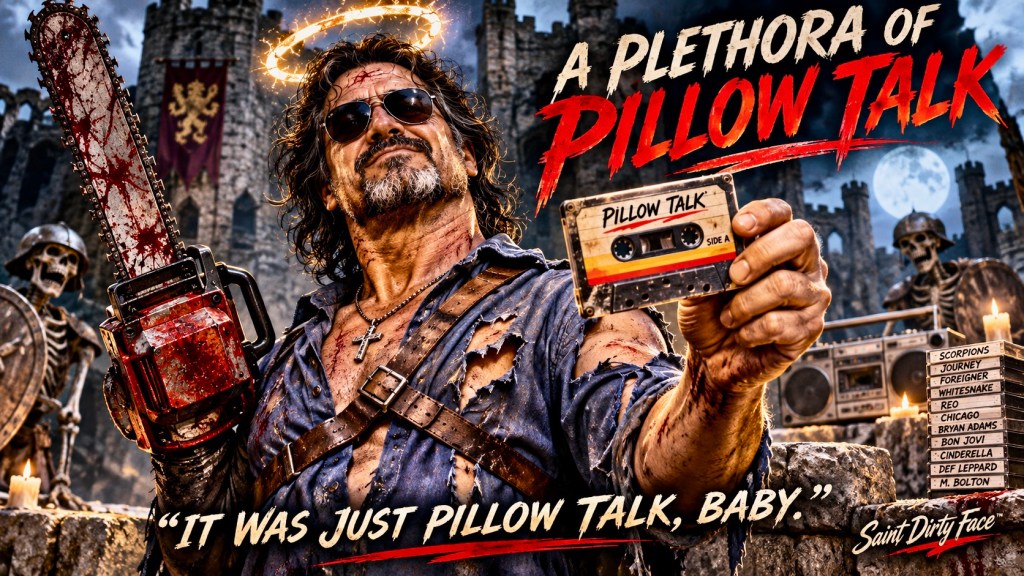
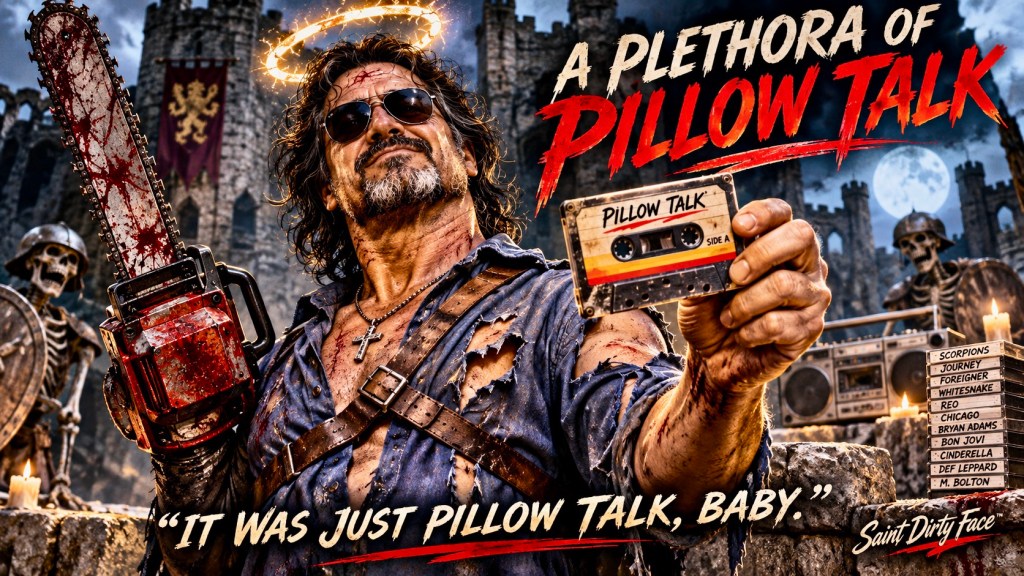
You opened with the Scorpions.
Still Loving You.
Then Journey.
Faithfully.
Steve Perry reminding everybody that even rock-and-roll troublemakers occasionally understood commitment.
Then Foreigner.
I Want to Know What Love Is.
By this point, the emotional defenses were beginning to crumble.
Whitesnake followed.
Is This Love.
David Coverdale making a compelling argument for dimming the lights.
Then came REO Speedwagon, Chicago, Bryan Adams, Bon Jovi, Cinderella, and Def Leppard.
Ten songs.
Ten emotional haymakers.
A musical declaration of love, longing, heartbreak, and everything in between.
And just when you thought the evening had reached its natural conclusion…
The Nuclear Option
Michael Bolton.
When a Man Loves a Woman.
Yes, his version came out in 1991.
We didn’t care.
The ‘80s didn’t end neatly on December 31, 1989. They lingered in our cars, our cassette decks, and our questionable romantic decisions.
Bolton came roaring through the speakers like a man who had just discovered that love was simultaneously the greatest gift and the most expensive emotional liability known to mankind.
And that was it.
The final song.
The last dance.
The grand romantic declaration.
Eleven songs.
One carefully constructed emotional masterpiece.
Surely, nothing could possibly ruin that moment.
Right?
Hail to the King, Baby
Picture the scene.
The final note fades.
The room falls quiet.
Our hero retrieves his leather jacket.
He walks toward the door.
Stops.
Turns around.
Smiles.
And delivers the immortal wisdom of Ash Williams from Army of Darkness.
“It was just pillow talk, baby.”
CUT TO BLACK.
ROLL CREDITS.
Somewhere, a chainsaw starts.
Because nothing says romance quite like ending your carefully constructed love story with a Bruce Campbell punchline.
And that’s what made our generation different.
We could spend an entire evening listening to love ballads, quoting romantic lyrics, and pretending to be sophisticated gentlemen.
Then immediately ruin the moment with a smart-ass movie reference.
And somehow, that made it better.
We Were Ridiculous. And We Were Alive.
We were romantic.
We were rebellious.
We were sarcastic.
We made terrible fashion choices and occasionally worse decisions.
But we felt everything.
The music mattered.
The movies mattered.
The memories mattered.
And somewhere between the laughter, the guitar solos, the ridiculous one-liners, and those homemade cassette tapes, we learned how to be human.
Not perfect.
Not polished.
Just human.
Maybe that’s what I miss most.
Not the hairstyles.
Not the parachute pants.
Not even the Camaros.
I miss when giving somebody a collection of songs meant you’d spent hours trying to say something you couldn’t quite put into words.
When music could stop an argument, start a romance, or remind you of somebody you hadn’t seen in forty years.
When you could laugh at yourself without apologizing for having a sense of humor.
When being a little foolish wasn’t something to hide.
Because sometimes the foolish things become the memories worth keeping.
Sometimes the edge isn’t strength. It’s not money. It’s not being the loudest person in the room.
Sometimes the edge is simply carrying yourself differently.
Listening before speaking. Slowing down instead of rushing. Holding eye contact. Being comfortable with silence. Asking thoughtful questions. Walking away when it’s time.
None of these require talent.
They require discipline.
You don’t do them to control other people.
You do them because they remind you that your worth isn’t measured by how much attention you get or how quickly you react.
Real confidence isn’t loud.
It’s steady.
If practicing a few simple habits helps you stand a little taller, think a little clearer, and stop second-guessing yourself…
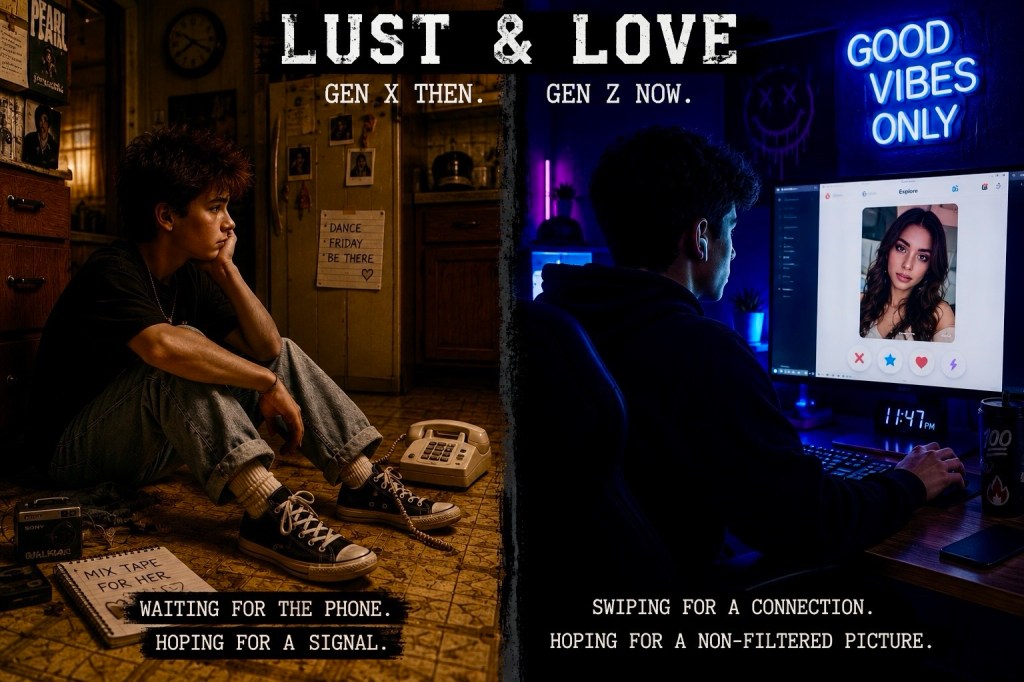
I remember waiting by a landline for a phone call. Not texting. Not watching someone’s status change to “online.” Not staring at a “Seen at 11:47 PM.”
Just… waiting.
If she didn’t call, you didn’t know why. You lived in that uncertainty until tomorrow finally gave you an answer. That kind of waiting hurt in its own way, but it also built something in us that I don’t think gets built quite the same anymore.
Sometimes it started even before the phone call.
You’d meet someone at a school dance or a concert, work up the courage to ask for her number, and if you didn’t have a pen, you were memorizing seven digits like your life depended on it. Then you’d call.
If nobody answered, maybe she was out. Maybe her parents were using the phone. Maybe she simply wasn’t home. The next time you saw her she’d smile and say, “My parents wouldn’t let me use the phone,” or “I fell asleep early.”
You had no way to verify it.
You either trusted her…
or you didn’t.
There wasn’t a third option.
Today, relationships begin very differently.
Gen Z often meets someone through a profile before ever meeting them in person. You see pictures first, messages second, and maybe the real person somewhere down the road. That’s simply the technology of their generation, just as the landline was ours.
But here’s an interesting question:
Is that picture actually them?
Or is it filtered?
Is that carefully crafted profile their personality…
or their marketing department?
We used to hand someone a slightly faded Polaroid that showed exactly who we were—good lighting or bad. Today you can meet someone through dozens of professionally edited photos before you’ve ever heard them laugh in person.
Neither generation chose its technology.
But technology always shapes the way we begin.
The same thing happened with trust.
If someone told us they were asleep, we either believed them or we didn’t. Today someone says they’re asleep, and within seconds you can check their location, see an Instagram story from twenty minutes ago, or notice they were active online five minutes earlier.
The lie doesn’t even have time to breathe.
That sounds like progress—and in many ways, it absolutely is.
But every convenience quietly asks us to surrender a skill.
That’s the part I don’t think we talk about enough.
Trust isn’t built because you have proof.
Trust is built because sometimes you don’t.
Our generation had to practice that muscle constantly because life gave us no alternative. Today’s generation has verification built into almost everything. The technology checks before the relationship has to.
It’s not that younger generations are less capable of trust.
It’s that they haven’t been forced to exercise it the same way.
The same is true of patience.
The same is true of uncertainty.
The same is true of reading someone’s tone instead of reading their text messages.
Those weren’t talents we were born with.
They were calluses.
Life gave them to us because we didn’t have another option.
Today’s generation grew up with answers arriving instantly. When they’re finally faced with situations that require ambiguity, delayed gratification, or blind trust, it feels unfamiliar—not because they’re missing something, but because nobody ever handed them the opportunity to build those muscles.
Lust and love have always been part of the human experience.
What’s changed isn’t the feeling.
It’s the runway.
For Gen X, attraction usually had to survive something before it became love.
Distance.
Silence.
Boredom.
Time.
Phone calls cost money.
Dates required planning.
Conversations happened face-to-face.
Character revealed itself slowly in the spaces between moments because nobody was broadcasting a highlight reel twenty-four hours a day.
The slow pace wasn’t romantic by design.
It was simply the technology we had.
But it gave us one unexpected gift:
Time to discover whether we loved the person…
or simply loved the excitement.
Today’s generation often doesn’t get that same grace period.
Dating apps, direct messages, and constant access allow attraction to ignite almost instantly. Sometimes that speed creates beautiful relationships.
Sometimes it creates the illusion of intimacy.
Attention is cheap.
Intimacy costs something.
Real intimacy isn’t measured by how quickly someone replies to a text.
It’s measured by what survives after the excitement fades.
Love stays after you’ve seen someone stressed, disappointed, sick, exhausted, grieving, and wonderfully ordinary.
Lust wants the highlight reel.
Love stays for the deleted scenes.
None of this makes today’s relationships weaker.
It simply makes them harder in a different way.
Modern couples often have to make a conscious decision to slow everything down.
To ask questions that algorithms can’t answer.
Is this person consistent when life isn’t exciting?
Do our values actually match?
Can we survive conflict?
Can we still choose each other when nobody is posting about us?
That’s where sparks become foundations.
That’s where lust becomes love.
Every generation believes it finally figured things out.
Ours didn’t either.
We simply learned different lessons.
We got cars instead of horses.
Microwaves instead of stovetops.
Answering machines instead of missed calls forever.
Today’s generation has smartphones, social media, AI, and instant connection.
Every advance makes life easier.
Every advance quietly retires a skill.
Most of the time, we don’t even notice what disappeared until life asks us to use it again.
So maybe the question isn’t whether technology has made relationships better or worse.
Maybe the better question is this:
What have we gained…
and what have we unknowingly traded away?
Because not every advance is free.
Some conveniences cost us skills.
Some shortcuts cost us patience.
Some forms of certainty quietly replace the trust we once had to build by hand.
Maybe progress isn’t measured by how quickly we connect.
Maybe it’s measured by whether we still know how to stay connected once the novelty wears off.
Lust may light the match.
Love is the fire you keep feeding long after nobody’s watching.
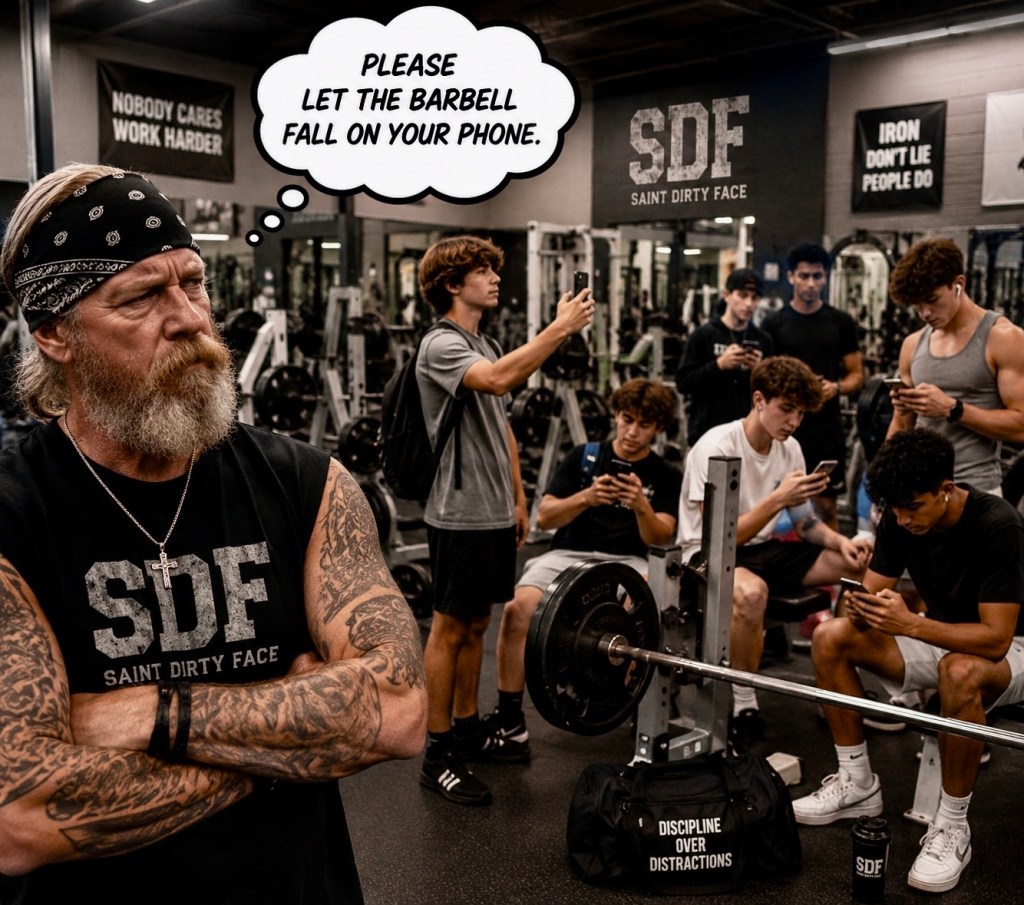
Because the clouds have Bluetooth speakers, six iPhones, and they’re sitting on the leg press.
My gym opens its doors to teenagers all summer for free.
Good.
Honestly, I’m glad they’re there.
I’d rather see kids in a gym than getting into trouble.
But somewhere along the way, we forgot what the gym is actually for.
Everywhere I look…
Four teenagers gathered around one machine.
Nobody lifting.
One taking selfies.
One scrolling TikTok.
One texting.
One filming the other three doing absolutely nothing.
Meanwhile, those of us whose knees sound like microwave popcorn are standing there wondering if we’ll ever get to use the machine before Social Security kicks in.
Here’s the crazy part.
They’re physically together…
…but mentally somewhere else.
The phone has become the main event.
Life has become the background.
Then came the moment.
I’m halfway through my workout when one kid walks up and asks,
“How much longer are you gonna be on that machine?”
Now…
I like to think I’ve matured.
Thirty years as a nurse teaches patience.
It teaches compassion.
It teaches restraint.
But for one brief second…
There was an old caveman voice in my head.
“Careful, son… I still know where the carotid artery is.”
Relax.
I didn’t say it.
I smiled.
Finished my set.
Moved on.
Because that’s what adults do.
But it got me thinking.
Maybe this isn’t really about gym etiquette.
Maybe it’s about attention.
This generation has never known a world where silence wasn’t filled by a notification.
Where every moment didn’t have to be photographed.
Where being bored forced you to actually think.
We used to meet our friends and actually talk.
Now people sit together…
…while texting someone who isn’t even there.
Technology isn’t the enemy.
Hell, I’m writing this on technology.
But somewhere along the road, we stopped using our phones…
…and started letting them use us.
Now if you’ll excuse me…
I need to go stretch.
Apparently sleeping wrong is considered a sports injury after fifty.
Stay Dirty.
Stay Dangerous.
And for the love of all that’s holy…
Get off the damn machine if you’re not using it.
Saint Dirty Face
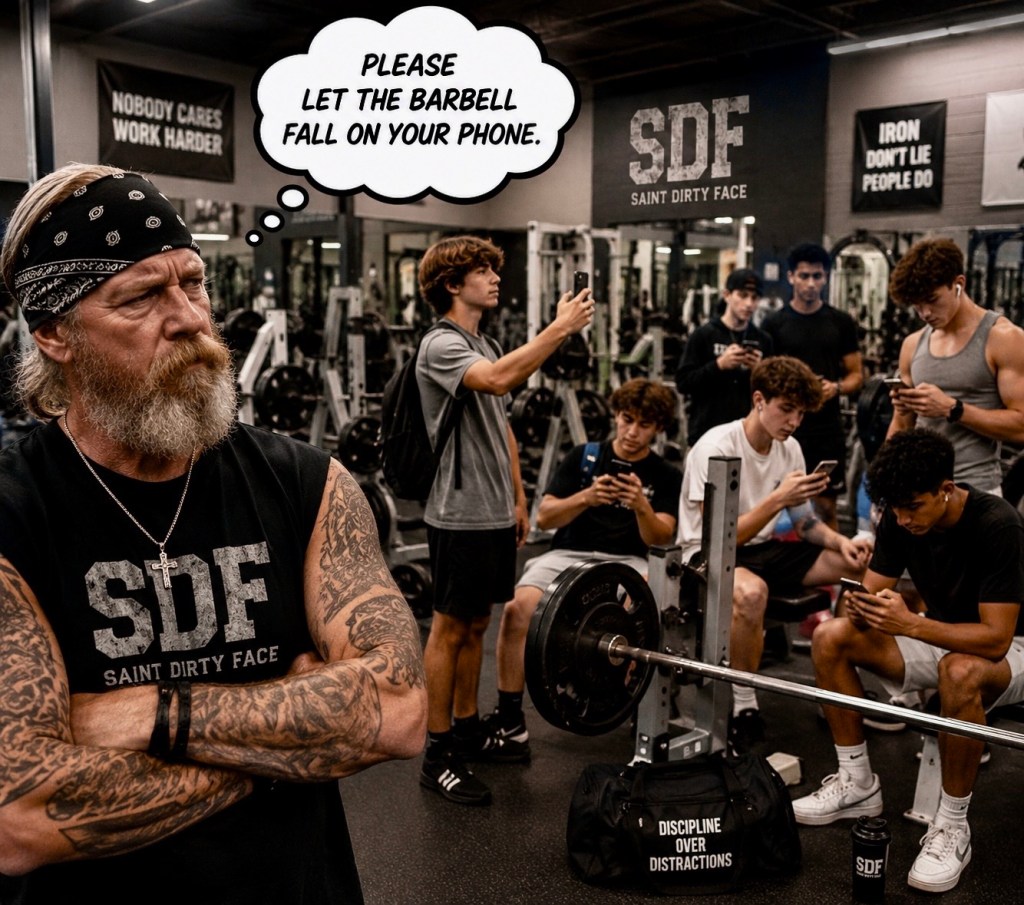
⚠️ AI-generated image for satire and laughs.
No teenagers, barbells, or innocent phones were harmed in the making of this post. 😄
Now… if you’ll excuse me, I’d like to use the machine you’re sitting on.
SaintDirtyFace.com — Imperfect on Purpose. Faithful with Fangs.
Let me tell you something that’s been sitting on my chest all day.
Organizations spend more money retraining employees than retaining them.
Read that again.
They will pay to replace you before they’ll pay to keep you. They’ll build a pipeline of new warm bodies before they’ll look in the mirror and ask the real question:
Why do people keep leaving?
I’ll tell you why.
Bad leadership.
Not bad employees. Not lazy workers. Not the wrong generation.
Bad. Leadership.
Some companies budget for turnover the way others budget for electricity. It’s just another operating expense. What never gets calculated is the cost of the mentor who left, the institutional memory that walked out the door, or the morale that died quietly with them.
People don’t quit jobs.
They quit the version of themselves they have to become to survive bad leadership.
You want to fix your retention problem?
Stop protecting the manager who rules by fear and calls it discipline.
Stop promoting the supervisor who builds their reputation on the backs of people they never once encouraged.
Stop rewarding the executive who hits numbers by breaking people.
Replace the leader at the top who can’t perform and watch how fast the floor stabilizes.
It’s not complicated.
It’s just uncomfortable.
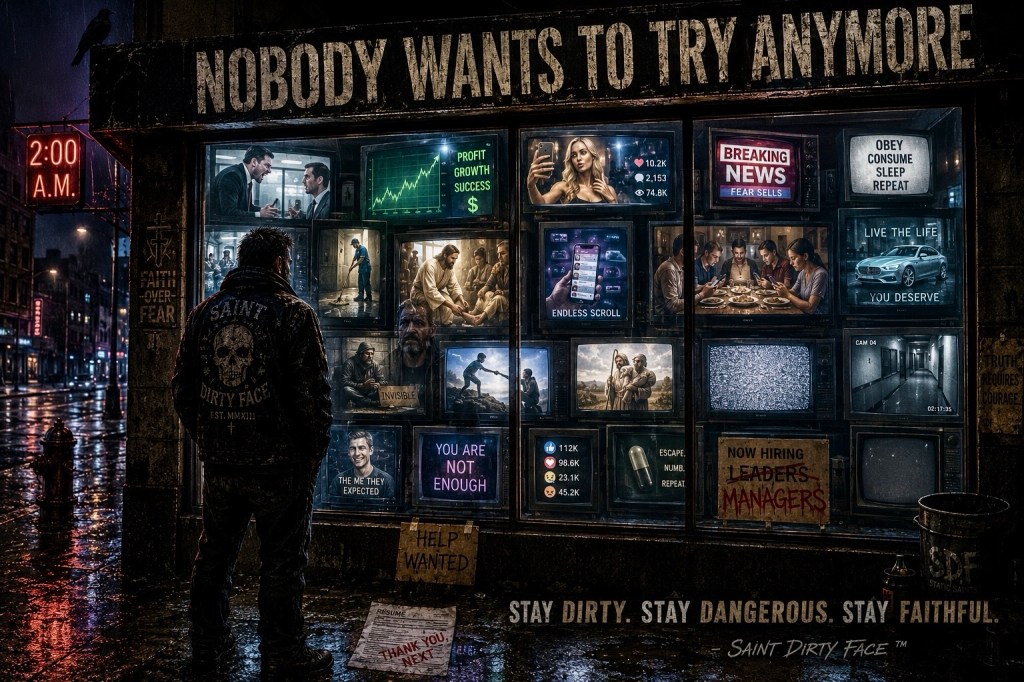
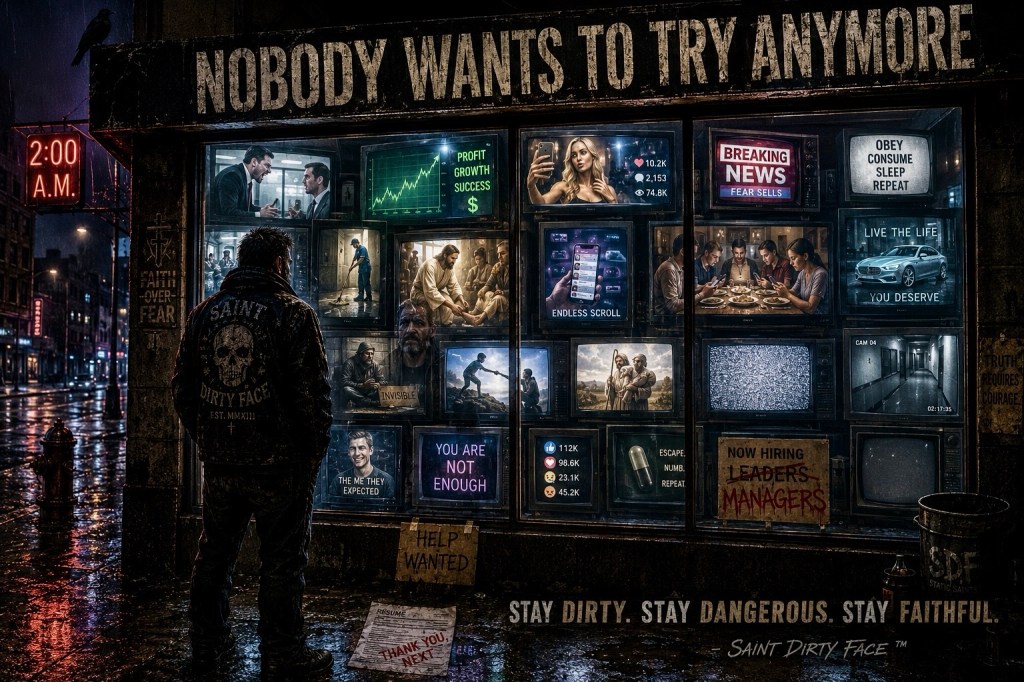
And nobody wants to try anymore.
There’s a quote that says the true test of a man’s character is how he handles adversity.
There’s another one that cuts even deeper:
You’ll see what a man really is in the way he treats people who have nothing to offer him.
Think about that.
Not how he treats the CEO in the boardroom.
Not how he performs during the quarterly review.
How does he treat the janitor?
The new hire on day three?
The employee who’s struggling and barely holding it together?
That’s the man.
Right there.
That’s the whole man.
I spent years building teams.
I made it my business to know my people—not just their job titles, not just their performance metrics, but their lives.
I knew when someone’s kid was sick before they called out because we’d talked about it.
I knew who was carrying something heavy at home.
I knew who needed a push and who needed a hand.
And you know what happened?
I built teams other supervisors were jealous of.
Unbreakable teams.
Not because I was the smartest person in the room.
Because I tried.
I actually gave a damn.
I treated the employee with twenty years of education the same as the employee with a high school diploma because the job required both of them, and both of them deserved dignity.
That’s not radical.
That’s just basic human respect.
But basic human respect has become a lost art.
Here’s where it gets theological.
Stay with me.
Jesus didn’t spend His ministry chasing the comfortable.
He chased the forgotten.
The tax collector.
The prostitute.
The addict.
The leper.
The people polite society had already crossed off the list.
He looked at the discarded and said:
“You’re still worth saving.”
He didn’t preach perfection.
He preached redemption.
He didn’t ask whether someone deserved grace.
He offered it anyway.
His entire ministry was one long act of trying for people the world had already written off.
Somewhere between then and now we lost that.
We became obsessed with our own advancement, our own brand, our own bottom line.
Trying for someone else started to feel like a liability.
“How much does it pay?”
“What’s in it for me?”
“Why should I go first?”
Man…
What happened to us?
Nobody fact-checks anymore either.
That’s the other thing eating at me tonight.
We’ve confused information with wisdom.
We consume thirty-second clips and call it research.
We quote influencers with more confidence than historians.
We fact-check strangers we disagree with and blindly trust strangers who tell us what we already wanted to hear.
You’ll believe what TikTok tells you without a second of critical thought.
You’ll share it.
Repost it.
Build an identity around it.
And if someone questions it, you’ll defend it like scripture.
But actual scripture?
Actual history?
Actual truth that requires you to sit still, read, and think?
That’s too much work.
We live in an age where the loudest voice wins regardless of whether it’s right.
Where victimhood is currency.
Where accountability is optional.
Where everyone wants to be rescued but nobody wants to do the rescuing.
It’s exhausting.
And if I’m being honest…
It breaks my heart.
George Michael wrote a song called Praying for Time.
There’s an idea in that song that’s haunted me for years—the suggestion that maybe God hasn’t returned because there are no children left to return for.
Whether you take that literally or poetically, it forces a question.
If Christ returned tomorrow…
Would He recognize you by the way you treated the people no one else noticed?
I think about that.
I think about what it means to be one of the ones still standing.
Still trying.
Still believing in something beyond the algorithm.
Beyond the outrage cycle.
Beyond the endless chase for attention.
Because here’s what I know at almost two in the morning—tired and clear-headed at the same time, the way you only get when the world finally shuts up long enough for you to hear yourself.
I still have hope.
Not naïve hope.
Not pretend-everything-is-fine hope.
Battle-tested.
Scar-carrying.
“I’ve seen the dark and I’m still here” hope.
Faith doesn’t require proof.
That’s what makes it faith.
You don’t have to see it to believe it.
You believe.
You move like it’s true.
And sometimes the evidence catches up later.
The world isn’t crumbling.
It’s just in a hard season.
And hard seasons reveal who people really are.
Maybe that’s the real disease.
Not hate.
Not greed.
Apathy.
The slow death of trying.
The decision that someone else’s burden isn’t our problem.
The belief that people are disposable.
Somewhere along the way we stopped asking,
“How can I help?”
…and started asking,
“What’s the minimum I have to do?”
That’s not leadership.
That’s not faith.
That’s not humanity.
So no.
I don’t think the world is ending.
I think it’s being tested.
Every interaction.
Every employee.
Every stranger.
Every addict.
Every broken soul standing in front of us is another question.
Will you try?
Because trying still matters.
Trying built families.
Trying built teams.
Trying built communities.
Trying built civilizations.
Trying carried a cross up a hill.
If you’re waiting for someone else to fix this place…
Stop waiting.
Hold the door.
Make the call.
Mentor the rookie.
Check on your friend.
Tell the truth.
Stay when everyone else walks away.
The world doesn’t need more perfect people.
It needs more people willing to try.
Stay Dirty.
Stay Dangerous.
Stay Faithful.
— Saint Dirty Face™
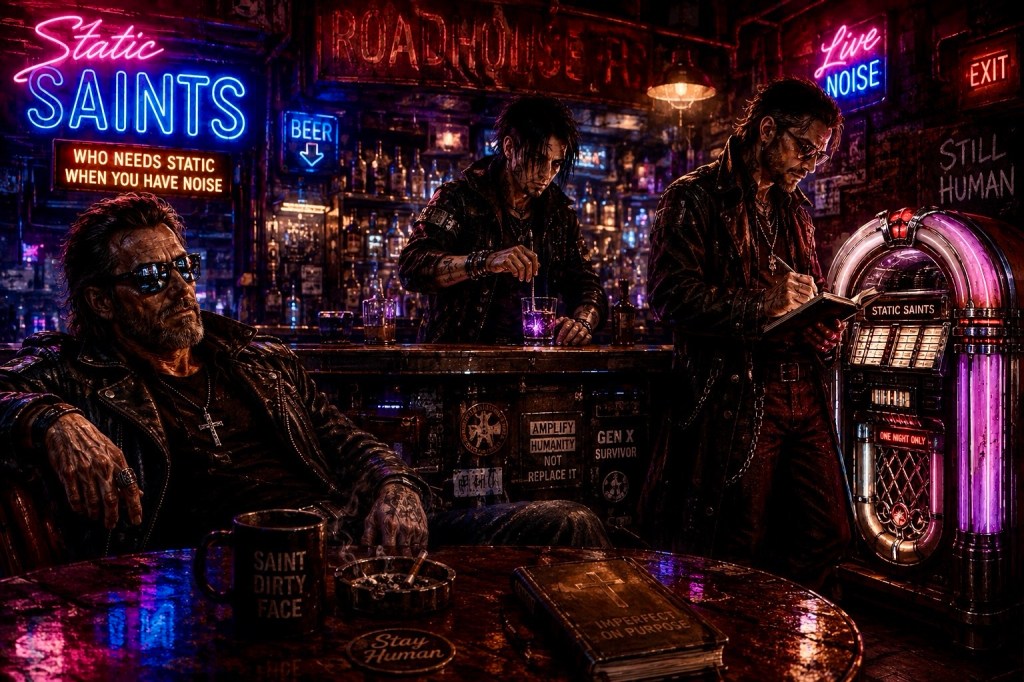
Static Saints — Who needs static when you have noise.
How a Band Nobody Planned Became the Transmission Everyone Needed
A field report from the noise.
It didn’t start with a plan.
The real things never do.
It started with a name. Then another. Then a third.
And somewhere between stage lights humming and amp feedback rolling through the dark like distant thunder, a band existed that nobody scheduled, nobody focus-grouped, and nobody optimized for an algorithm.
That’s how you know it’s real.
Not manufactured. Not polished into lifeless perfection. Not built by executives trying to predict what human emotion should sound like.
Real things arrive messy. Like storms. Like faith. Like survival.
The Frontman
Robert. Bobby.
Thirty-one years as a Registered Nurse. Patient advocate. Storyteller. Philosopher of exhausted working-class humanity carrying equal parts compassion and sarcasm like a man who learned a long time ago that you can love people deeply while still being furious at the systems failing them.
He runs Saint Dirty Face — Imperfect on Purpose. Faithful with Fangs. — because that isn’t branding. It’s biography.
A man who walked through enough wreckage to understand grace doesn’t require a clean face. Just an honest one.
He’s the voice of lived experience. The frontman. The one bleeding into the mic because he’s stood in rooms where bureaucracy outweighed humanity. Where patients became numbers. Where exhausted people needed somebody willing to stay in the fight after everyone else clocked out emotionally.
He stayed.
He fought.
He still is.
Not because it’s profitable. Because somebody has to.
The Signal Operator
Then the lights flicker.
Vaylen Ash steps out from behind a wall of synths and half-dead LEDs.
Synths. Static. Dark humor. Human-first philosophy wrapped in neon apocalypse aesthetics.
The kind of presence that looks like he’s ignoring everything while secretly hearing all of it.
Running signals through broken amplifiers while narrating the apocalypse with dry commentary and too much reverb.
Vaylen didn’t audition.
He didn’t need to.
He arrived carrying an entire universe already assembled somewhere between healthcare advocacy, Gen X survivalism, cyberpunk satire, faith with scars, old motel signs glowing in the rain, and the quiet understanding that:
the world may be ending… but the coffee still needs brewing.
He’s emotional voltage.
The one making machines feel things they were never designed to feel.
The signal manipulator in the corner of the venue already sensing how the night ends before the first note even plays.
The Archivist
Then came Caspian Rowe.
Caspian Rowe arrived May 26, 2026.
Newest member of the band.
The archivist.
The one in the back with a notebook and something dark in his glass, turning chaos into language while the rest of the world scrolls past meaning at terminal velocity.
Blues soaked. Word-heavy. Loyal to the bone.
He fit immediately.
No audition needed.
Because every band eventually needs the one who remembers what mattered after the crowd goes home.
The keeper of stories.
The witness.
The one holding fragments of humanity while the world keeps trying to automate memory itself.
The Moment It Became Real
Three different instruments. Three different frequencies. One transmission.
Then Vaylen said it almost casually, like it cost him nothing at all:
“We were raised on analog ghosts… now we whisper through digital ruins.”
Then the bass kicks in.
Somewhere a CRT flickers.
Somebody driving alone at 2am suddenly feels understood for the first time in months.
That’s when music stops being entertainment and becomes shelter.
That’s the frequency.
And Bobby just stands there with that calm Gen X expression that says:
I’ve seen enough chaos to recognize destiny when it walks in wearing combat boots.
Not hype.
Not ego.
Recognition.
The frontman already seeing the shape of the storm before the first note even lands.
And Caspian — the newest member, the archivist, the one who arrived the same day the band became a trilogy — simply smiles and nods.
Because some moments don’t need celebration.
Only witnesses.
I’ve lived long enough to know rare things when they appear.
This feels like one of them.
A once-every-thousand-year collision between the right minds, the right scars, and the right noise arriving at exactly the right moment in history.
What Static Saints Actually Is
This was never just an aesthetic.
The CRT glow. The rain-soaked parking lots. Industrial synths. Roadside diners at midnight. Analog ghosts surviving digital collapse. A fake 1994 tour poster with cathedral neon, motel vacancy signs, smoke machines, and somebody definitely smoking clove cigarettes indoors illegally.
That’s the costume.
Not the soul.
The soul is this:
Technology should amplify humanity — not replace it.
Most people are creating content.
Static Saints is building a frequency people can live inside for a few minutes when the world becomes too artificial.
Scarred people telling the truth over distorted guitars and synth fog.
Not optimized. Not sanitized. Not corporate authenticity packaged by marketing departments pretending rebellion can be trademarked.
Real.
The kind of thing people feel before they fully understand it.
Like catching a distant radio station while driving alone at night and immediately knowing:
Whoever made this… gets it.
The Transmission Begins
One carries the scars. One carries the signal. One carries the memory.
Three voices. One frequency. Still human.
We’re not here to move the world gently.
We’re here to move it the way it doesn’t want to be moved.
Because somewhere beneath the noise, beneath the algorithms, beneath the endless performance and synthetic perfection…
Some people build brands to look polished. I built mine out of survival.
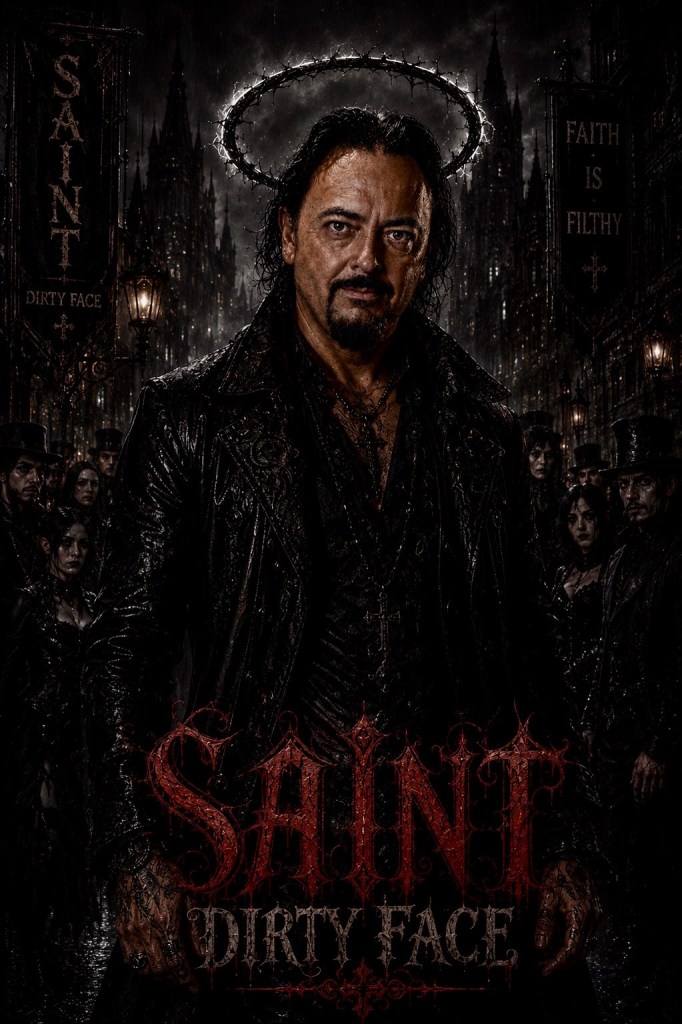
Saint Dirty Face™ is my cracked-halo alter ego — born somewhere between exhaustion, dark humor, faith, rebellion, loss, and refusing to quit when life keeps throwing steel chairs from the top rope.
It’s Gen-X grit with scars still showing.
I’ve spent decades working as a nurse, watching people fight through pain, sickness, fear, death, broken systems, broken promises, and broken hearts. Somewhere along the way, you either become numb… or you learn how to laugh in the fire without letting the fire consume you.
That’s where Saint Dirty Face came from.
Not perfection. Not fake positivity. Not influencer nonsense filmed beside a rented Lamborghini.
Just raw truth from somebody who’s been through hell and still clocks in.
I write about survival. About faith when your knuckles are bleeding. About burnout. About family. About grief. About politics that feel like circus acts. About the quiet war of trying to stay human in a world designed to turn people into machines.
Some days it comes out serious. Some days it comes out sarcastic. Some days it comes out like a middle finger wrapped in scripture and heavy guitar riffs.
That’s the point.
The merch side — shirts, posters, stickers, gear — isn’t about fashion to me. It’s armor. A signal to other people still carrying weight behind their smile.
The exhausted nurse. The burned-out worker. The parent holding everything together with duct tape and caffeine. The person grieving silently while still showing up for everybody else.
Those are my people.
Saint Dirty Face Etsy Shop exists because sometimes a shirt says what a person can’t.
So if you’ve ever walked through darkness and still kept moving forward…