Do Not Disturb. We’re Trying to Remember Each Other.
At twenty-five, you worried about whether the neighbors could hear you.
Twenty years later, you worry about whether somebody will knock and ask where the printer paper is.
Desire gets some strange working conditions.
You can spend an entire day handling problems, answering messages, remembering appointments, and being the person who knows which drawer contains the batteries. Then your partner gives you that look.
You know the look.
You still like the look.
Unfortunately, your brain has fourteen tabs open, three overdue notices, and a smoke detector chirping somewhere in the background.
“Come here,” they say.
“I’m coming. Mentally, I’m still on hold with the insurance company.”
There’s something absurd about sharing a home with the person you want and having to arrange a temporary evacuation of your own responsibilities to enjoy them.
But there’s tenderness in figuring it out together.
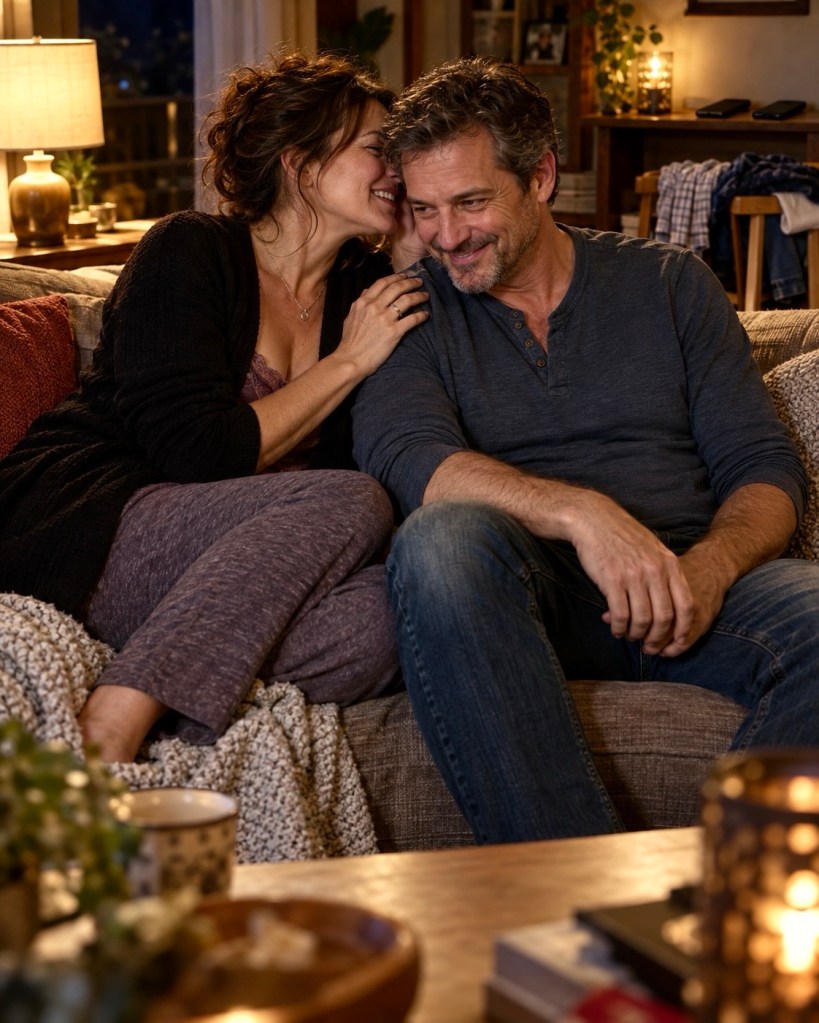
One of you locks the door. The other puts both phones somewhere inconvenient. You sit close enough to remember that this person has a smell you love. They say something filthy under their breath, and you laugh harder than the joke deserves because, for once, nobody needs an answer.
You get to be a little useless together.
The laundry can spend another evening developing its personality on the chair.
Maybe the night gets spicy. Maybe you kiss for a while and fall asleep with a hand somewhere familiar. Neither of you has to turn the evening into a performance review.
Still, give yourselves a chance.
A closed door. A little privacy. Enough quiet to hear an invitation.
And if somebody knocks to ask about printer paper?
They can discover a drawer. It’ll build character.
Some people call it holding a grudge when you stop volunteering for the same injury.
You can forgive someone and still remove their access to you.
That isn’t cruelty. It isn’t revenge. And it sure as hell isn’t bitterness.
It’s pattern recognition.
You remember what happened. You believe what they repeatedly showed you. And you finally stop handing them another opportunity just because they arrived carrying an apology and the emotional equivalent of gas-station flowers.
Compassion doesn’t require amnesia.
You can hope they heal without letting them practice on you. You can understand their damage without offering yours as company. You can love who they were—or who you thought they might become—and still lock the damn door.
Somewhere along the way, I stopped needing the world to understand me.
I’m 54 years old.
Fifty-four winters. Fifty-four years of living, loving, losing, winning, screwing things up, making things right, burning bridges, building bridges, and occasionally wondering how the hell I made it this far.
I’ve been the good guy.
I’ve been the asshole.
I’ve been the man who stood his ground when he probably should have walked away. And I’ve been the man who walked away when every fiber of his being wanted to stay and fight.
I’ve made mistakes I can’t undo. I’ve said things I can’t take back. I’ve trusted people I shouldn’t have, and I’ve probably disappointed people who deserved better from me.
That’s life.
That’s my life.
And for the first time in a long time, I can look at all of it without feeling the need to explain myself.
Not because I’m proud of every decision.
Not because I don’t have regrets.
But because I’ve finally accepted that every chapter, including the ugly ones, belongs to me.
The Man in the Rain
The other night, I heard a song for the first time.
It stopped me.
Not because it was the greatest song ever written. Not because of some incredible guitar solo or a voice that could shake the heavens.
It stopped me because I recognized myself in it.
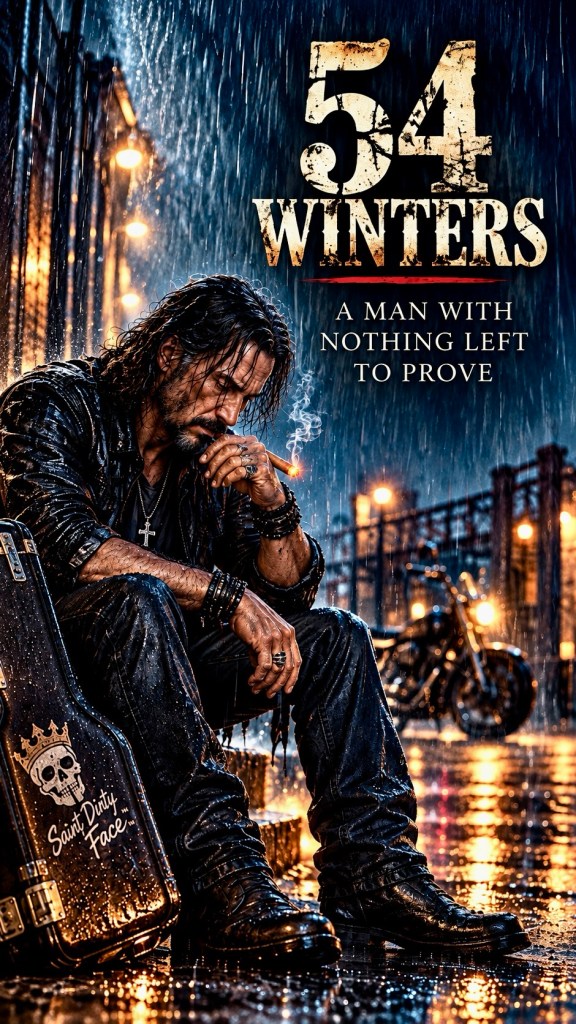
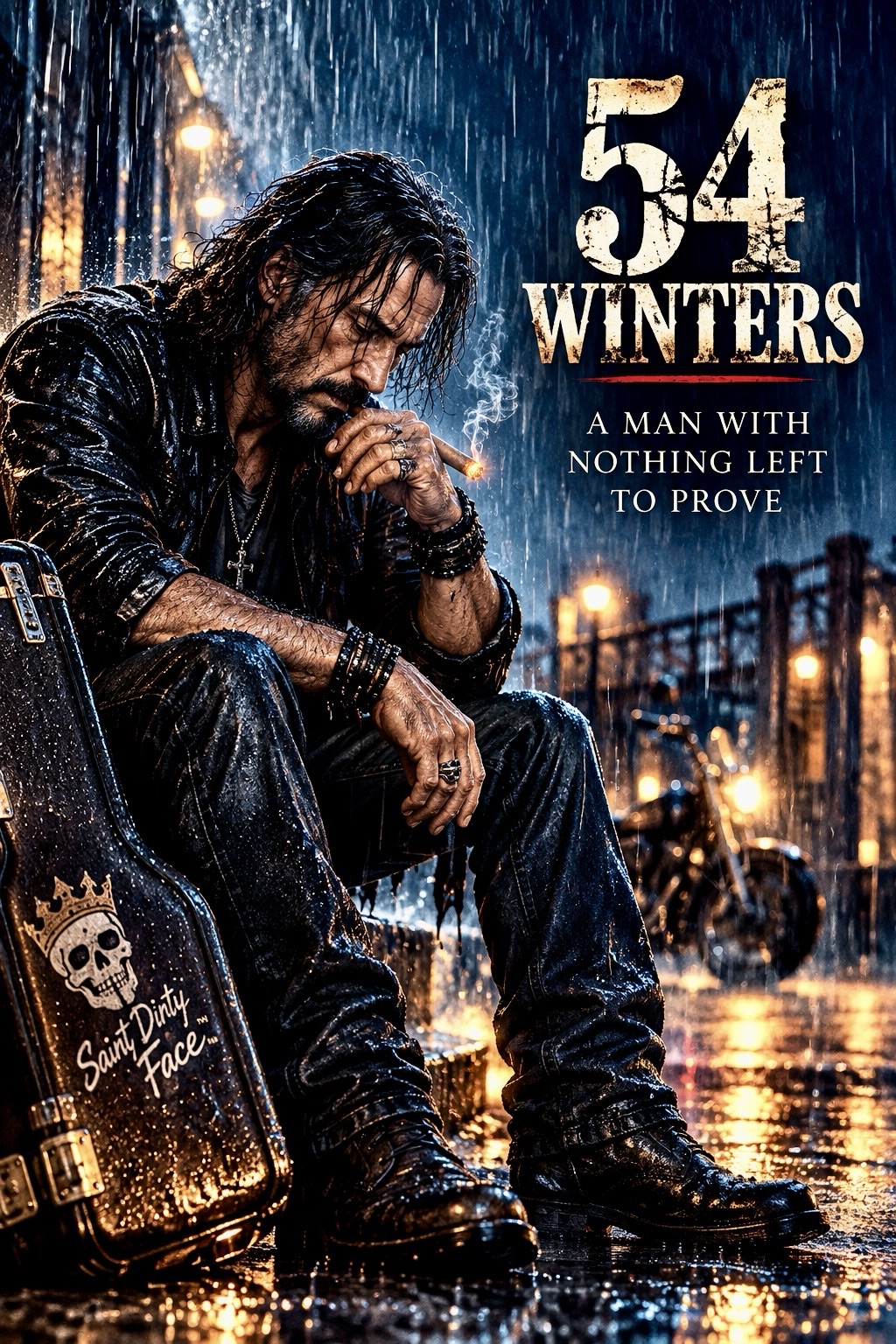
On the screen was a weathered man standing in the pouring rain. Long hair, scars, a cigarette, and a face that looked like it had seen a few things.
I looked at him and saw peace.
Some people might see sadness. Others might see loneliness or defeat.
I saw something different.
I saw a man who wasn’t running from the rain.
He was letting it fall.
Because rain isn’t always a storm to survive.
Sometimes it’s what washes you clean.
Water cleanses. It refreshes. It gives life. It washes away the dust we’ve carried for miles.
And standing there, looking at that image, I realized something.
I’m no longer trying to escape every storm. Sometimes I just want to stand in the rain and let it wash over me.
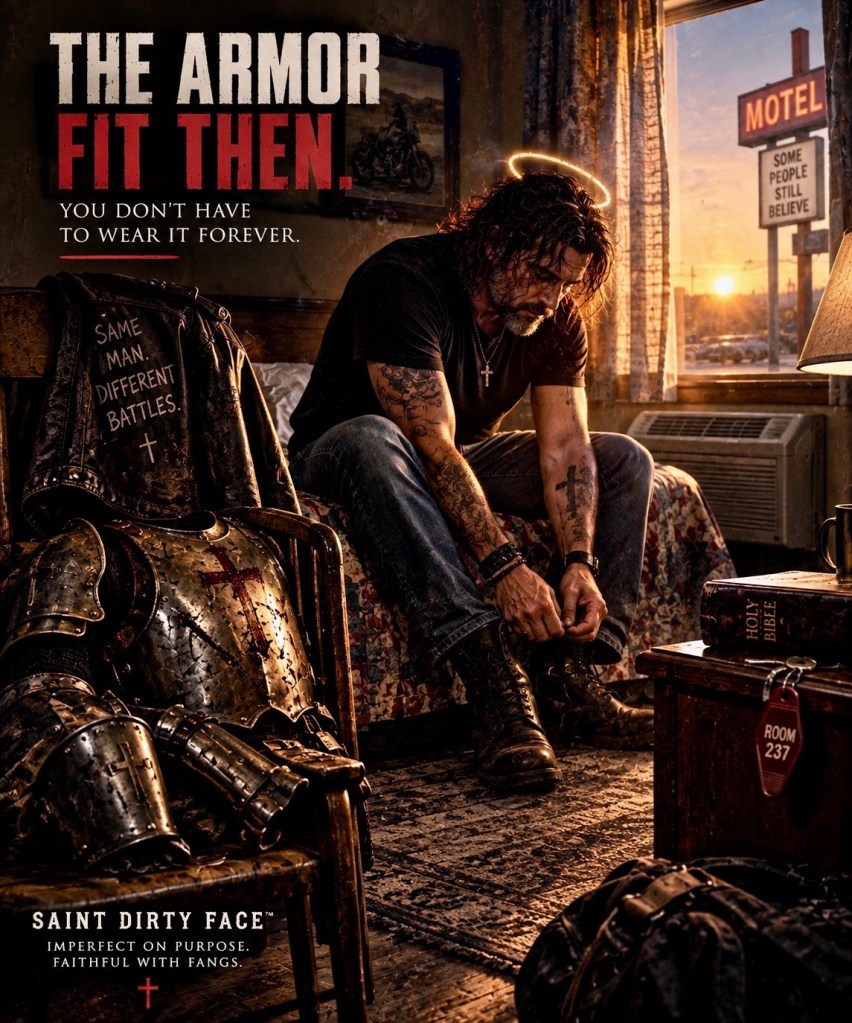
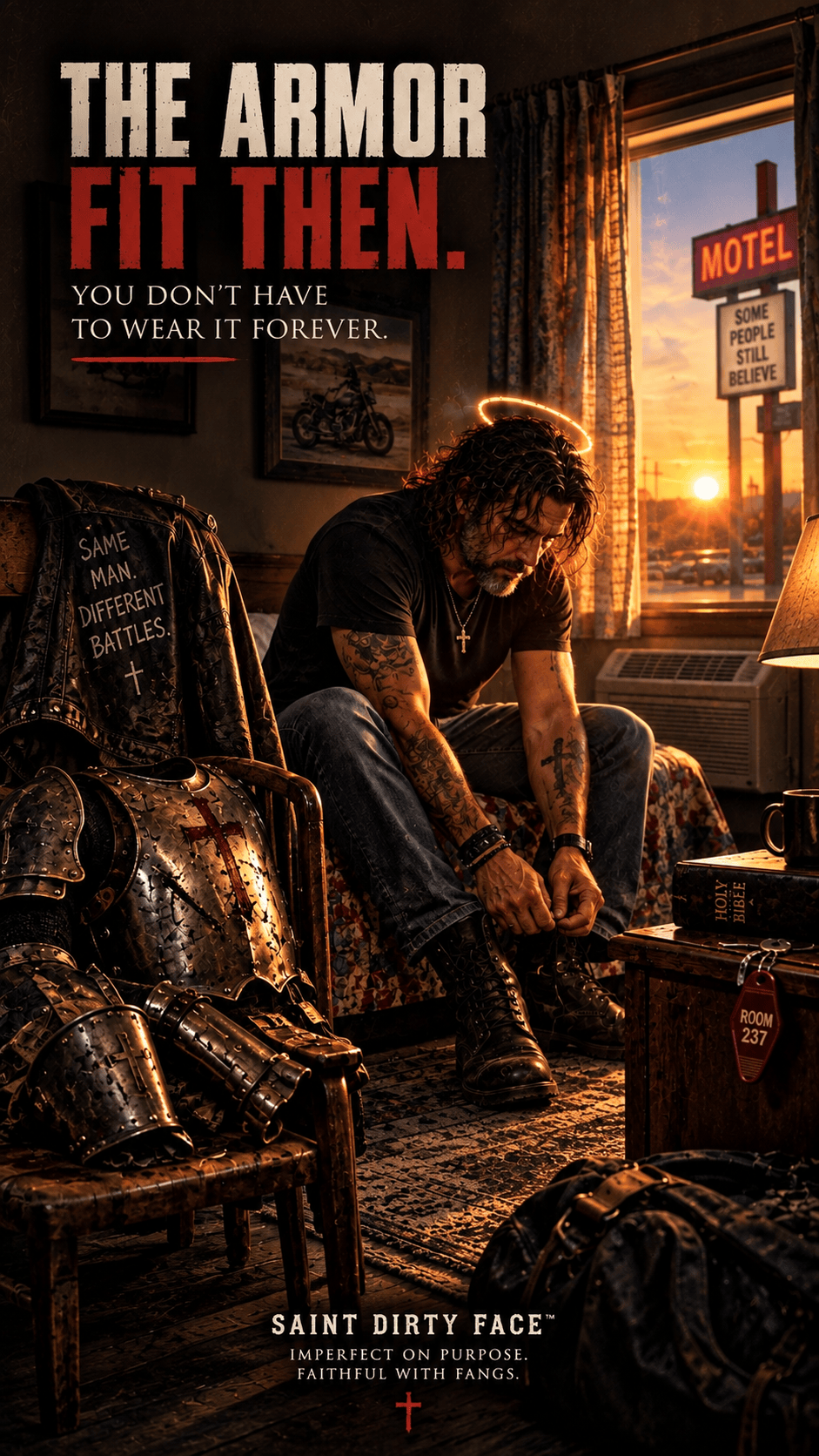
The Armor Gets Heavy
I’ve worn armor most of my life.
Not the kind you can see.
The kind you build after being hurt, disappointed, betrayed, challenged, or forced to become stronger than you ever wanted to be.
Armor that says, Don’t let them see you hurt.
Don’t let them see you cry.
Don’t back down.
Don’t show weakness.
And for a long time, that armor served a purpose.
It protected me.
But here’s something nobody tells you about wearing armor for decades.
Eventually, you forget how to take the damn thing off.
You start treating every disagreement like a battle. Every criticism like an attack. Every disappointment like another reason to build the walls higher.
And before you know it, you’re exhausted from fighting wars that nobody else even knows you’re fighting.
I’m learning to take mine off.
Some days it’s easy.
Other days, that old armor fits a little too comfortably.
But I’m getting better.
I don’t have to answer every insult.
I don’t have to correct every idiot.
And believe me, there are days when that last one requires the patience of a saint.
A very dirty-faced saint. 😏
I still get angry. I still have a temper. I still have moments when the darkness in my eyes returns and that old fire starts burning.
I even have a name for that darker side of me.
Torbet.
He’s been around a long time.
And I’m not going to pretend he’s gone.
But he’s no longer running the show.
I can feel the anger rising, recognize it, take a breath, and ask myself a question I wish I’d learned to ask decades ago.
Is this really worth my peace?
More often than not, the answer is no.
And I walk away.
Head held high.
Not defeated.
Just finished.
I Cry Now. So What?
Here’s something else that’s changed.
I cry.
A sad song can get me.
A scene in a movie can get me.
Sometimes it’s a memory. Sometimes it’s something beautiful. Sometimes it’s something heartbreaking that has absolutely nothing to do with my own life.
And you know what?
I don’t give a damn who sees it.
I’m not embarrassed.
I’m not apologizing.
I’m a 54-year-old man who has experienced enough life to understand that tears aren’t evidence of weakness.
They’re evidence that something still reaches me.
That after everything I’ve seen, everything I’ve endured, and everything I’ve lost, I can still feel deeply.
I consider that a blessing.
I spent enough years trying to be tough.
These days, I’d rather be real.
The Past Doesn’t Get to Own My Present
There are things in my past that still sting.
There are people I wish had acted differently. Situations I wish had ended another way. Things I built that didn’t last. Battles I fought that probably weren’t worth fighting.
And yes, there are moments when I still get angry thinking about them.
I’m not going to lie and say I’ve reached some magical level of enlightenment where nothing bothers me anymore.
Bullshit.
I’m still me.
But something has changed.
I no longer want to live there.
I can remember what happened without moving back into it.
I can acknowledge the injustice without making it my daily responsibility to correct the entire world.
I can recognize that something mattered deeply to me, even if it didn’t matter to somebody else.
And I can move forward without receiving the apology, acknowledgment, or recognition I once believed I needed.
Sometimes my pride still whispers, They should remember what you did.
And maybe they should.
But the quieter part of me answers, You remember. Isn’t that enough?
These days, it is.
I’m not erasing my history.
I’m just refusing to let it write the rest of my story.
A Crew of One
For much of my adult life, I felt responsible for more than myself.
I wanted to protect people. Stand up for them. Fight injustice. Speak when others couldn’t or wouldn’t.
Sometimes I succeeded.
Sometimes I made things harder than they needed to be.
But I cared.
And I still do.
The difference now is that I’ve realized I don’t have to carry everyone else’s battles on my shoulders.
For the first time in a very long time, I’m a crew of one.
And there’s something liberating about that.
It doesn’t mean I’m alone.
I have people I love. People who matter. People I’d still go through hell for.
It means I’m finally taking responsibility for my own peace instead of constantly sacrificing it trying to fix everything around me.
I can help without becoming consumed.
I can care without carrying the entire world.
And I can say no without writing a three-page explanation.
That’s freedom.
Another Morning, Another Gift
One of the most meaningful changes in my life happens before the day even gets started.
I wake up.
And I thank Yeshua.
For another day.
For the gift of life.
For my family. For my friends. For the people I love having another opportunity to experience this world.
I don’t ask for a perfect day.
I don’t expect every problem to disappear.
I simply recognize that I have been given something that isn’t guaranteed to any of us.
Another sunrise.
Another chance to laugh.
Another chance to love.
Another chance to make something right.
Another chance to be a better man than I was yesterday.
There was a time when I might have opened my eyes and immediately started thinking about everything I needed to accomplish, everything that needed fixing, and every problem waiting for me.
Now I try to begin with gratitude.
I’m here.
The people I love are here.
And today is a gift.
That’s enough to start with.
Regrets That Can Still Be Fixed
I still have regrets.
Hell, I suspect I’ll collect a few more before this ride is over.
But there’s a difference between the regrets I carried for decades and the ones I experience now.
The old ones sometimes belong to a world that no longer exists.
The people have changed. The circumstances have changed. The opportunity to make things right may have passed.
I’ve had to learn to live with that.
But today’s regrets?
Those are different.
If I say something stupid, I can apologize.
If I hurt someone, I can try to make it right.
If I make a poor decision, I can change direction.
I don’t have to defend every mistake just because my pride doesn’t want to admit I made one.
And I don’t have to turn one bad moment into an entire bad day.
That’s something I’m still learning.
Maybe I’ll be learning it until my last winter.
I’m okay with that.
Happiness Without Permission
Something unexpected happened when I stopped trying so hard to be understood.
I became happy.
Not the loud, look-at-me kind of happy.
Not the kind that requires photographs, applause, recognition, or somebody telling me how wonderful my life is.
A quieter happiness.
The kind that lets me enjoy music without thinking about tomorrow.
The kind that lets me create something simply because I want to.
The kind that lets me laugh at something ridiculous, spend time with people I love, or sit in silence without feeling like I should be doing something more productive.
I’ve started new adventures. I’ve created things. I’ve rediscovered parts of myself that had been buried beneath responsibility, expectations, and years of trying to hold everything together.
And somewhere in all of that, I realized I don’t need an audience.
I don’t need everybody to like me.
I don’t need everybody to remember me.
I don’t even need everybody to understand me.
I know who I am.
And for the first time, that feels like enough.
Here’s to Another 54 Winters
I don’t know what the future holds.
Nobody does.
I could spend the next twenty years worrying about it, trying to control it, trying to prepare for every possibility.
Or I could live today.
That doesn’t mean abandoning responsibility or pretending tomorrow doesn’t matter.
It means refusing to sacrifice every beautiful moment of the present to a future that hasn’t happened yet.
I’m 54.
I’ve walked through some fires.
I’ve stood in some storms.
I’ve built things, broken things, loved people, lost people, made mistakes, and occasionally gotten a few things right.
I’ve been angry.
I’ve been afraid.
I’ve been proud.
I’ve been humbled.
And yes, I’ve cried.
I don’t regret becoming the man I am, even if there are parts of the journey I wish had been different.
Because today, I can look in the mirror and recognize him.
Not a perfect man.
Not a saint.
Certainly not a man who has everything figured out.
Just a man who’s finally learning that peace doesn’t require winning every battle.
And if the world wants to see my scars, let it look.
If it sees my tears, let them fall.
I’m not ashamed.
I’m not hiding.
I’m not asking for permission to be myself.
The past is behind me.
The present is mine.
And the future?
We’ll see what happens when we get there.
For now, I’m going to enjoy the rain.
Here’s to another 54 winters.
And here’s to the man who finally learned he doesn’t have to fight through every single one of them.
Nobody prepares you for what romance looks like after you’ve been together long enough.
When you’re young, romance is candlelight.
Hotel rooms.
Making out in the kitchen because dinner can wait.
You imagine marriage will be falling asleep wrapped around the person you love.
And sometimes it is.
Other times…
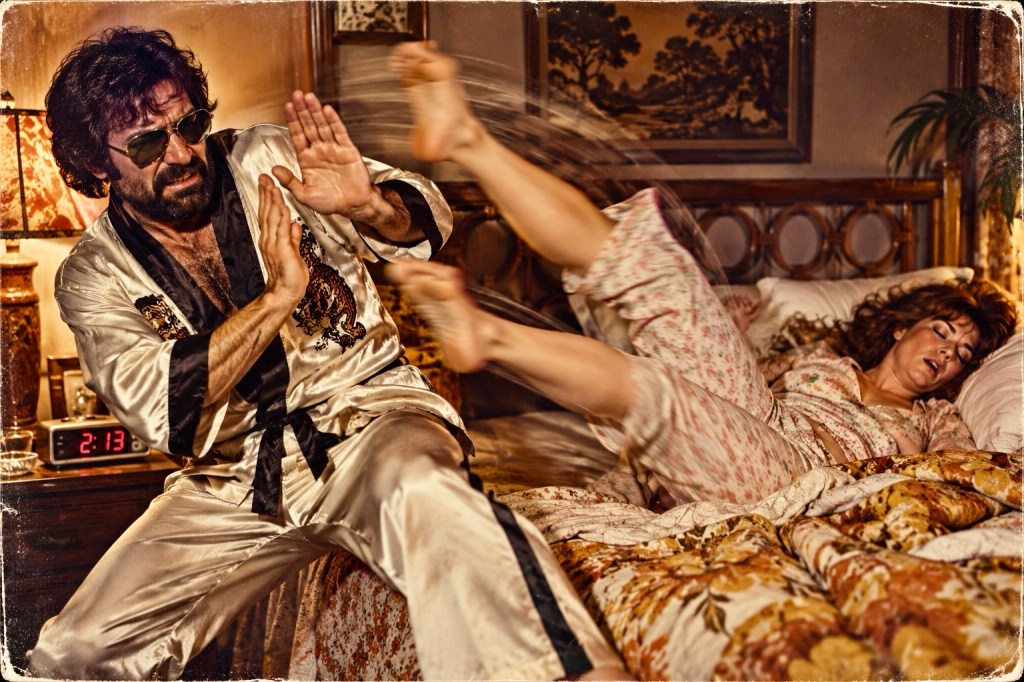
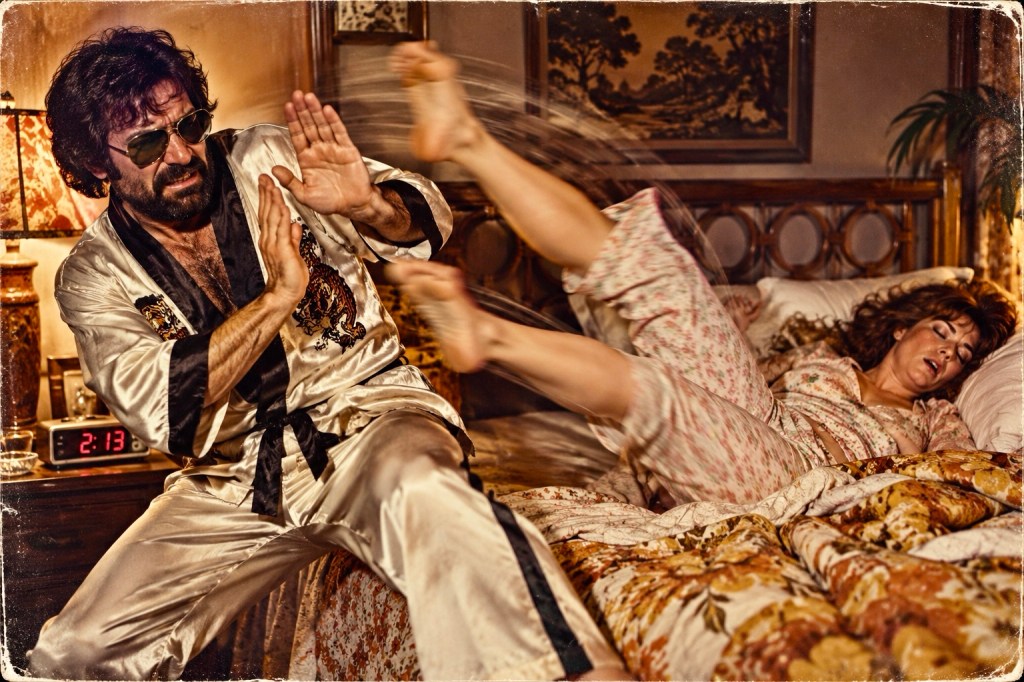
your wife passes out by 9 PM, you crawl into bed later hoping for a little affection, and the only thing you have to kiss is her restless legs syndrome.
Because apparently her legs have somewhere to fucking be.
You try to cuddle her.
Kick.
Move closer.
Twitch.
Put your arm around her.
DOUBLE KICK.
At some point you realize you’re not spooning your wife anymore.
You’re trying to restrain a raccoon in a sleeping bag.
And that’s marriage after 40.
Sometimes romance isn’t champagne, rose petals, and sex until sunrise.
Sometimes romance is trying to cuddle your wife while her legs fight invisible bees.
And you know what?
You still move closer.
Because underneath the snoring, the twitching, the blankets somebody stole, the thermostat negotiations, and the occasional heel directly into your shin…
that’s still your person.
The one you chose.
The one you built a life with.
The one you’d still kiss in the kitchen on a random Tuesday.
Assuming she’s awake past nine.
And the invisible bees give you five goddamn minutes.
I’m apologizing because when it comes to live music—
Gen X cheated.
😂🤘
We got to see the bands that now appear on your vintage T-shirts.
And they weren’t holograms.
They weren’t reunion tours featuring one original member, somebody’s cousin and a drummer they found behind a Guitar Center.
They were the fucking band.
We saw Metallica when Metallica was dangerous.
Guns N’ Roses when nobody knew whether Axl was going to finish the show, start a riot, or both.
Mötley Crüe when the backstage stories probably violated several international treaties.
Van Halen.
AC/DC.
Ozzy.
Aerosmith.
Def Leppard.
Bon Jovi.
Journey.
Iron Maiden.
Judas Priest.
The Cure.
Depeche Mode.
U2.
Pearl Jam.
Soundgarden.
Alice in Chains.
Nirvana.
Tool.
Nine Inch Nails.
Pantera.
And dozens more.
Some of us caught the legends who came before us, too.
Pink Floyd.
The Rolling Stones.
Paul McCartney.
Eric Clapton.
I never got to see Led Zeppelin.
That’s one I would’ve given damn near anything to experience.
But I did get to see Page & Plant together on tour, while Jimmy Page and Robert Plant could still walk onto a stage and remind you exactly where all those younger bands got some of their DNA.
It wasn’t Zeppelin.
But brother—
it was close enough to make the hair on your arms stand up.
And we didn’t experience these shows through somebody else’s vertical video with half the screen covered in comments.
We were there.
You bought the ticket.
Usually from an actual human being.
Then you somehow found your friends without GPS.
You walked into an arena carrying absolutely no device capable of contacting civilization.
Your parents had no idea where you were beyond:
“At the concert.”
That was considered sufficient information.
😂
Then the lights went down.
That moment.
Anybody who grew up going to concerts knows exactly what I’m talking about.
Twenty thousand people screaming.
The stage completely dark.
Then one guitar cuts through the room.
And every hair on your arms stands up because you know what’s coming.
There wasn’t a screen between you and it.
Your phone wasn’t above your head.
Because your phone was attached to the fucking kitchen wall.
You watched the show with your eyes.
You remembered it with your brain.
Mostly.
There are portions of the 1980s and ’90s still undergoing forensic reconstruction.
😂
And then came the next morning.
The concert shirt.
You didn’t carefully preserve the damn thing as collectible merchandise.
You wore it to school.
Immediately.
Preferably while your ears were still ringing.
And everybody walking through those hallways knew exactly who had been at the show the night before.
That shirt wasn’t fashion.
It was a receipt.
A medal.
A giant cotton middle finger to everybody whose parents wouldn’t let them go.
😂🤘
You’d see another kid wearing the same shirt from across the hallway and there didn’t even need to be a conversation.
Just the nod.
You were there too.
That was enough.
We stood in lines.
We got shoved against barricades.
We bought questionable merchandise in parking lots.
Our ears rang for two days afterward.
We held cigarette lighters in the air before somebody decided phone flashlights were safer and considerably less likely to set the guy in front of you on fire.
And somewhere along the way, without realizing it—
we were watching music history happen in real time.
That’s the part that hits differently now.
Some of those voices are gone.
Some of those bands don’t exist anymore.
Some will never stand together onstage again.
And that ticket stub sitting forgotten in somebody’s drawer isn’t just an old piece of paper anymore.
It’s proof.
The faded shirt isn’t just an old shirt.
It’s proof.
We were there.
That’s one thing about getting older nobody tells you.
Eventually the things you thought were just normal Friday nights become stories younger people wish they could’ve experienced.
And I’m not saying everything was better back then.
It wasn’t.
We had plenty of bullshit.
And concert bathrooms in the ’80s should probably qualify as Superfund sites.
But music?
Brother…
we caught one hell of a show.
We saw legends before we knew they were legends.
We watched bands become enormous.
We watched some implode.
We watched others somehow survive everything thrown at them.
And we walked out afterward half-deaf, sweaty, broke and completely fucking alive.
Thirty or forty years later, you can hear the opening notes of one of those songs and suddenly you’re not fifty-something anymore.
You’re seventeen.
The lights just went down.
Your friends are beside you.
Your ears haven’t started ringing yet.
And tomorrow morning—
you’re wearing the shirt to school.
Because before social media gave everybody a way to announce where they’d been…
we wore the evidence.
And if your ears are still ringing all these years later?
Apparently you bought the good seats.
WE DIDN’T WATCH THE DOCUMENTARY.
WE WERE IN THE FUCKING FOOTAGE.
WE WERE THERE.
SAINT DIRTY FACE™ Imperfect on Purpose. Faithful with Fangs.