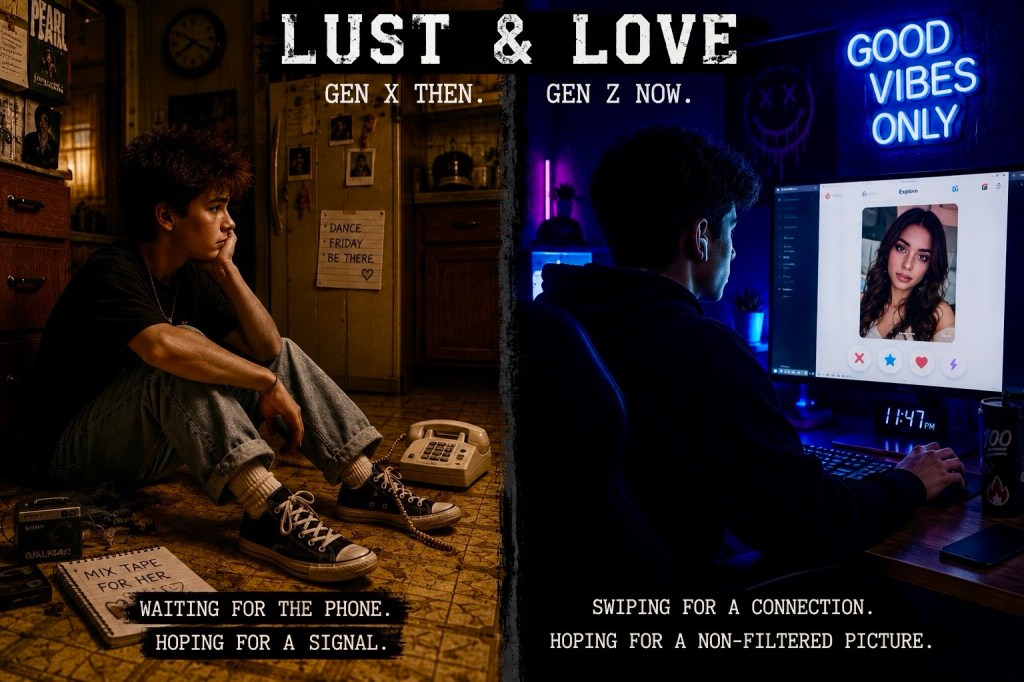
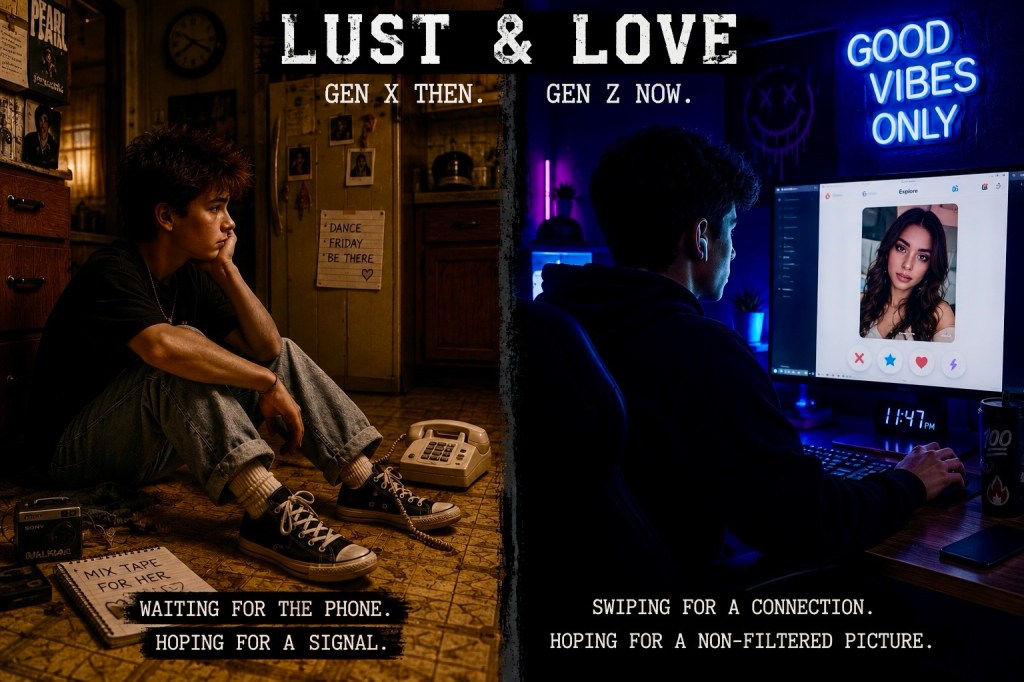
I remember waiting by a landline for a phone call. Not texting. Not watching someone’s status change to “online.” Not staring at a “Seen at 11:47 PM.”
Just… waiting.
If she didn’t call, you didn’t know why. You lived in that uncertainty until tomorrow finally gave you an answer. That kind of waiting hurt in its own way, but it also built something in us that I don’t think gets built quite the same anymore.
Sometimes it started even before the phone call.
You’d meet someone at a school dance or a concert, work up the courage to ask for her number, and if you didn’t have a pen, you were memorizing seven digits like your life depended on it. Then you’d call.
If nobody answered, maybe she was out. Maybe her parents were using the phone. Maybe she simply wasn’t home. The next time you saw her she’d smile and say, “My parents wouldn’t let me use the phone,” or “I fell asleep early.”
You had no way to verify it.
You either trusted her…
or you didn’t.
There wasn’t a third option.
Today, relationships begin very differently.
Gen Z often meets someone through a profile before ever meeting them in person. You see pictures first, messages second, and maybe the real person somewhere down the road. That’s simply the technology of their generation, just as the landline was ours.
But here’s an interesting question:
Is that picture actually them?
Or is it filtered?
Is that carefully crafted profile their personality…
or their marketing department?
We used to hand someone a slightly faded Polaroid that showed exactly who we were—good lighting or bad. Today you can meet someone through dozens of professionally edited photos before you’ve ever heard them laugh in person.
Neither generation chose its technology.
But technology always shapes the way we begin.
The same thing happened with trust.
If someone told us they were asleep, we either believed them or we didn’t. Today someone says they’re asleep, and within seconds you can check their location, see an Instagram story from twenty minutes ago, or notice they were active online five minutes earlier.
The lie doesn’t even have time to breathe.
That sounds like progress—and in many ways, it absolutely is.
But every convenience quietly asks us to surrender a skill.
That’s the part I don’t think we talk about enough.
Trust isn’t built because you have proof.
Trust is built because sometimes you don’t.
Our generation had to practice that muscle constantly because life gave us no alternative. Today’s generation has verification built into almost everything. The technology checks before the relationship has to.
It’s not that younger generations are less capable of trust.
It’s that they haven’t been forced to exercise it the same way.
The same is true of patience.
The same is true of uncertainty.
The same is true of reading someone’s tone instead of reading their text messages.
Those weren’t talents we were born with.
They were calluses.
Life gave them to us because we didn’t have another option.
Today’s generation grew up with answers arriving instantly. When they’re finally faced with situations that require ambiguity, delayed gratification, or blind trust, it feels unfamiliar—not because they’re missing something, but because nobody ever handed them the opportunity to build those muscles.
Lust and love have always been part of the human experience.
What’s changed isn’t the feeling.
It’s the runway.
For Gen X, attraction usually had to survive something before it became love.
Distance.
Silence.
Boredom.
Time.
Phone calls cost money.
Dates required planning.
Conversations happened face-to-face.
Character revealed itself slowly in the spaces between moments because nobody was broadcasting a highlight reel twenty-four hours a day.
The slow pace wasn’t romantic by design.
It was simply the technology we had.
But it gave us one unexpected gift:
Time to discover whether we loved the person…
or simply loved the excitement.
Today’s generation often doesn’t get that same grace period.
Dating apps, direct messages, and constant access allow attraction to ignite almost instantly. Sometimes that speed creates beautiful relationships.
Sometimes it creates the illusion of intimacy.
Attention is cheap.
Intimacy costs something.
Real intimacy isn’t measured by how quickly someone replies to a text.
It’s measured by what survives after the excitement fades.
Love stays after you’ve seen someone stressed, disappointed, sick, exhausted, grieving, and wonderfully ordinary.
Lust wants the highlight reel.
Love stays for the deleted scenes.
None of this makes today’s relationships weaker.
It simply makes them harder in a different way.
Modern couples often have to make a conscious decision to slow everything down.
To ask questions that algorithms can’t answer.
Is this person consistent when life isn’t exciting?
Do our values actually match?
Can we survive conflict?
Can we still choose each other when nobody is posting about us?
That’s where sparks become foundations.
That’s where lust becomes love.
Every generation believes it finally figured things out.
Ours didn’t either.
We simply learned different lessons.
We got cars instead of horses.
Microwaves instead of stovetops.
Answering machines instead of missed calls forever.
Today’s generation has smartphones, social media, AI, and instant connection.
Every advance makes life easier.
Every advance quietly retires a skill.
Most of the time, we don’t even notice what disappeared until life asks us to use it again.
So maybe the question isn’t whether technology has made relationships better or worse.
Maybe the better question is this:
What have we gained…
and what have we unknowingly traded away?
Because not every advance is free.
Some conveniences cost us skills.
Some shortcuts cost us patience.
Some forms of certainty quietly replace the trust we once had to build by hand.
Maybe progress isn’t measured by how quickly we connect.
Maybe it’s measured by whether we still know how to stay connected once the novelty wears off.
Lust may light the match.
Love is the fire you keep feeding long after nobody’s watching.
Stay Dirty. Stay Dangerous. Stay Faithful.


Leave a Reply