If Jesus walked into some churches built in His name, security might remove Him before the offering.
That thought has been sitting with me.
Not because every church is corrupt.
Many feed people, shelter families, bury the forgotten, visit the sick, and keep lights burning in communities everybody else abandoned.
Church buildings matter.
Community matters.
Gathering matters.
But a building can carry a cross without carrying Christ.
That distinction matters too.
Jesus did not arrive looking powerful.
No embroidered suit.
No reserved parking space.
No security detail clearing the aisle.
He looked ordinary enough that Judas had to identify Him with a kiss.
Think about that.
The soldiers needed someone to point out which unremarkable man was supposedly turning the world upside down.
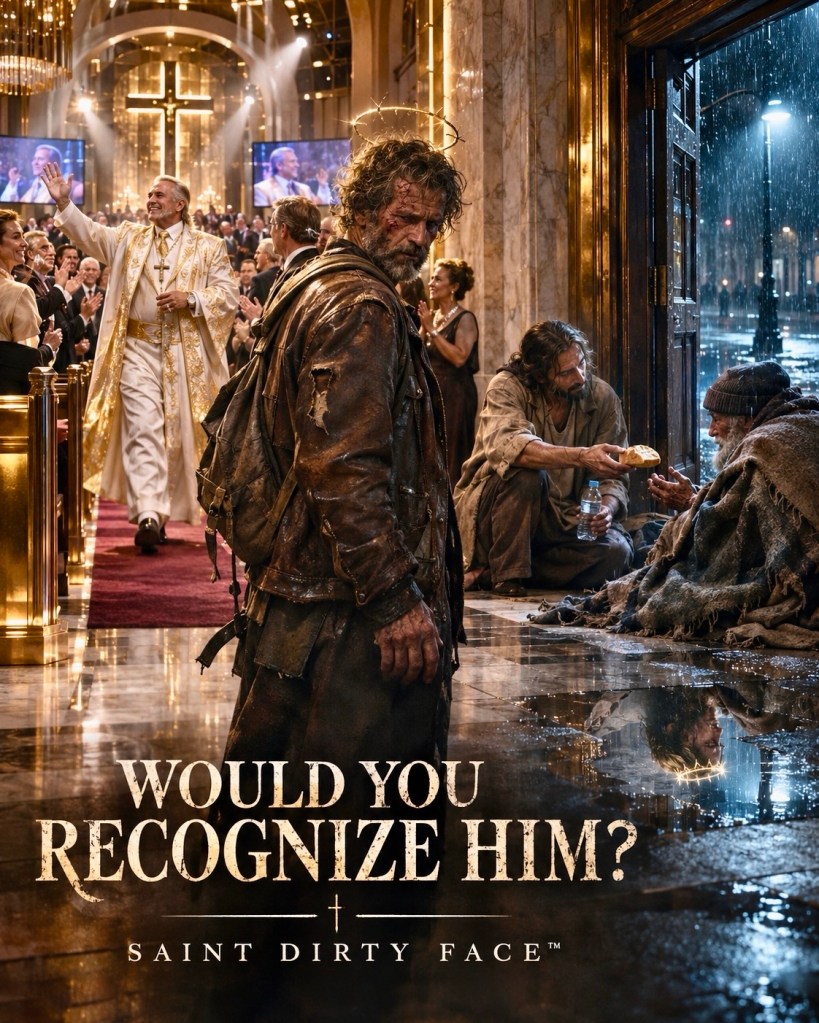
Now imagine Him arriving today.
Dust on His clothes.
Tired eyes.
Untrimmed hair.
Sitting near the entrance beside somebody who smells like the street.
Would we recognize Him?
Or would we ask both of them to wait outside while welcoming the wealthy preacher through another door?
Apparently holiness has developed a dress code and a donor tier.
We say God works through broken people—until a broken person actually walks into the room.
Then we want them cleaned up.
Stable.
Educated.
Properly medicated.
Preferably carrying proof of insurance.
We want testimony after the healing.
Not the shaking hands, withdrawal, confusion, anger, poverty, and inconvenient need that came before it.
But Jesus kept choosing inconvenient people.
The sick.
The poor.
The condemned.
The socially radioactive.
The woman everybody discussed but nobody defended.
The man everyone stepped around because helping him would interrupt the schedule.
He didn’t love suffering because suffering was holy.
He loved people others had decided were unworthy of interruption.
That is the test.
Not how loudly we sing.
Not how expensive the stage is.
Not whether the preacher owns enough teeth to illuminate the entire sanctuary.
The test is what happens when somebody enters with nothing to offer.
No influence.
No money.
No polished redemption story.
Just need.
Scripture doesn’t say money itself is the root of every evil. It warns about the love of money.
Still, we should probably be concerned when wealth becomes evidence of righteousness and poverty becomes evidence of poor character.
That isn’t faith.
That is capitalism wearing church clothes.
And before we point at institutions, the same warning belongs to each of us.
I can condemn the rich preacher and still ignore the hurting person beside me.
I can criticize a church for lacking compassion while guarding my own time, comfort, and wallet like sacred relics.
Hypocrisy doesn’t require a pulpit.
Sometimes it owns a mirror.
So this isn’t anti-church.
It is anti-church-that-forgets-Christ.
Because church was never supposed to exist only inside walls.
When you cannot reach the building, God has not misplaced your address.
Sit quietly.
Listen.
Look inward—not because you are God, but because your soul is still a place where God can meet you.
Prayer does not need stained glass to travel.
Faith does not require a microphone.
And compassion does not become holy only after somebody creates a committee for it.
Maybe Jesus is still walking among ordinary people.
Still dirty.
Still wounded.
Still easy to overlook.
And maybe the question was never whether He would recognize us.
Maybe the question is whether we would recognize Him.
— SAINT DIRTY FACE™
Imperfect on Purpose. Faithful with Fangs.


Leave a Reply