Power Ballads, Bad Decisions, and the Lost Art of Being Gen X
By Saint Dirty Face™
There was a time when men wore leather jackets, women wore enough hairspray to violate international environmental treaties, and love came with a guitar solo.
We didn’t have Spotify.
We didn’t have dating apps.
We had cassette tapes, questionable judgment, and enough confidence to believe that eleven carefully selected love songs could change somebody’s life.
Sometimes they did.
Sometimes they just got us into trouble.
Either way, we had one hell of a soundtrack.
A Plethora, El Jefe!
If you grew up in the ‘80s, you learned some of life’s most important lessons from movies that would probably send today’s internet into cardiac arrest.
Blazing Saddles.
Spaceballs.
History of the World, Part I.
Three Amigos!
Mel Brooks taught us that comedy could challenge almost anything.
Richard Pryor and Eddie Murphy taught us that laughter didn’t always have to be polite.
And Harlem Nights taught us that getting shot in the pinky toe could lead to a very unpleasant evening.
We quoted these movies until our friends begged us to stop.
Then we quoted them again.
Because when someone mentions a plethora, every properly educated Gen Xer knows there’s a joke coming.
And we still laugh.
Forty years later.
The Women Who Ruined Our Concentration
Vanity.
Apollonia.
Kelly LeBrock.
Phoebe Cates.
Lord have mercy.
The ‘80s weren’t just a decade. They were an assault on the adolescent nervous system.
Vanity brought dangerous glamour to The Last Dragon. And her real-life relationship with Mötley Crüe’s Nikki Sixx connected two worlds of ‘80s excess: Prince’s musical universe and the Sunset Strip.
Apollonia walked into Purple Rain and made an entire generation forget what they were supposed to be doing.
Kelly LeBrock in Weird Science?
Forget artificial intelligence. Those two boys had bigger technological ambitions than Silicon Valley.
And Phoebe Cates in Fast Times at Ridgemont High?
Let’s just say a generation of teenage boys suddenly developed a powerful appreciation for swimming pools.
We were young.
We were impressionable.
And subtlety was not exactly Hollywood’s strongest selling point.
We Were Almost Famous
Music wasn’t something we listened to.
It was something we lived inside.
Almost Famous captured that feeling beautifully.
The backstage passes. The tour buses. The musicians who were simultaneously brilliant, ridiculous, and one bad decision away from disaster.
The feeling that somewhere beyond the next highway exit, something extraordinary was waiting.
Then there was Crossroads.
One minute, Ralph Macchio was chasing the blues.
The next, Steve Vai appeared with a guitar and made us question everything we thought we knew about six strings.
That movie could send you straight into a lifelong appreciation of blues and guitar virtuosity.
From Muddy Waters and Howlin’ Wolf to B.B. King and Stevie Ray Vaughan.
And from Steve Vai to David Lee Roth and eventually Whitesnake.
That was the beauty of the era.
One movie.
One guitar solo.
One song.
And suddenly you had a new obsession.
The Sacred Art of the Mixtape
Now let’s discuss something that deserves its own place in the Smithsonian.
The romantic mixtape.
Young people today will never understand the pressure.
You couldn’t just drag songs into a playlist.
You sat beside the radio with your finger hovering over RECORD, praying the DJ would shut his damn mouth before the first guitar riff.
You calculated tape length.
You arranged the songs.
You wrote the titles by hand.
And if the cassette ran out halfway through the perfect love ballad?
Brother, you started over.
Because a mixtape wasn’t background music.
It was a love letter written in magnetic tape.
And song order mattered.
You didn’t just throw eleven tracks together and hope for the best.
You built a journey.
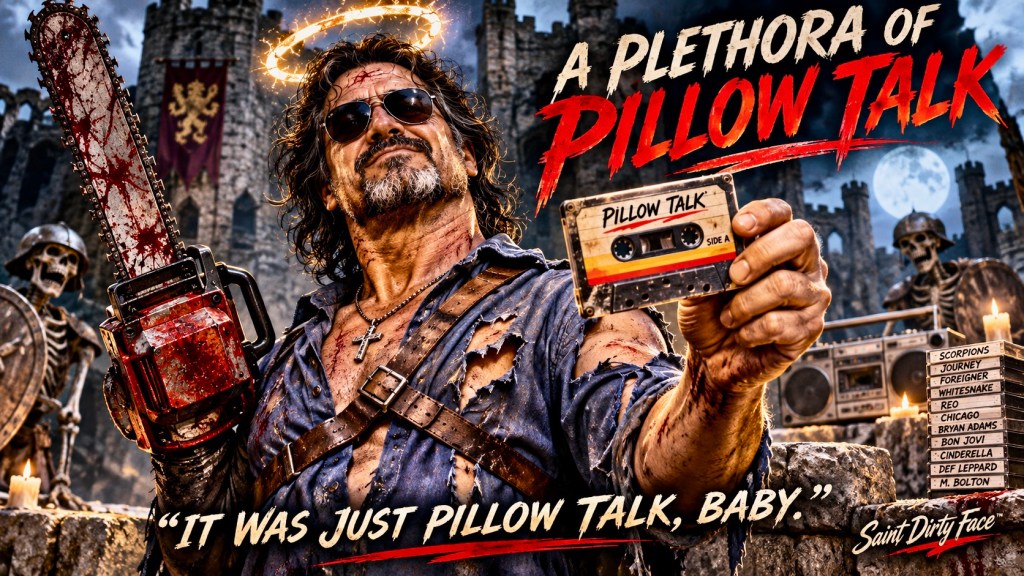
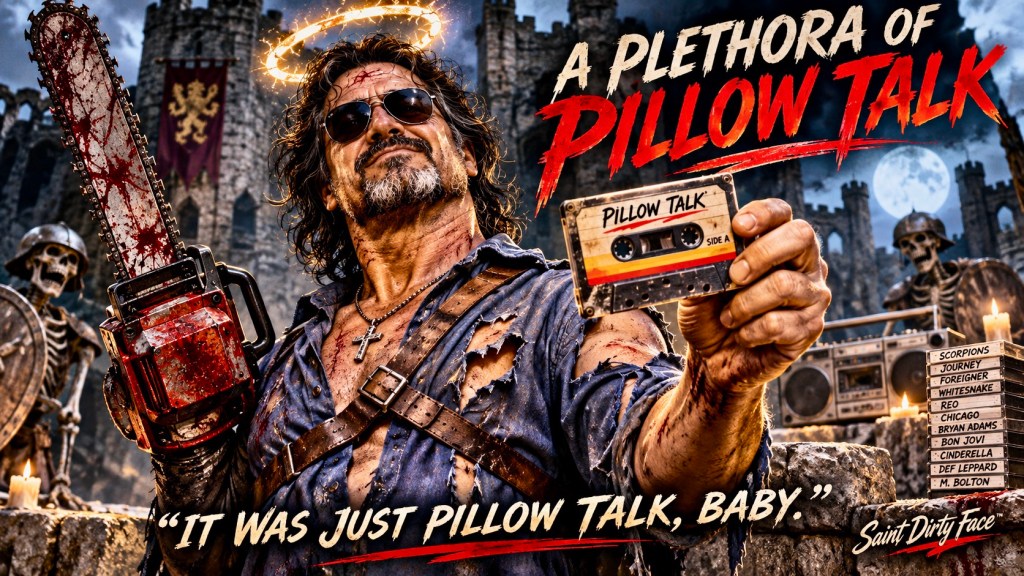
You opened with the Scorpions.
Still Loving You.
Then Journey.
Faithfully.
Steve Perry reminding everybody that even rock-and-roll troublemakers occasionally understood commitment.
Then Foreigner.
I Want to Know What Love Is.
By this point, the emotional defenses were beginning to crumble.
Whitesnake followed.
Is This Love.
David Coverdale making a compelling argument for dimming the lights.
Then came REO Speedwagon, Chicago, Bryan Adams, Bon Jovi, Cinderella, and Def Leppard.
Ten songs.
Ten emotional haymakers.
A musical declaration of love, longing, heartbreak, and everything in between.
And just when you thought the evening had reached its natural conclusion…
The Nuclear Option
Michael Bolton.
When a Man Loves a Woman.
Yes, his version came out in 1991.
We didn’t care.
The ‘80s didn’t end neatly on December 31, 1989. They lingered in our cars, our cassette decks, and our questionable romantic decisions.
Bolton came roaring through the speakers like a man who had just discovered that love was simultaneously the greatest gift and the most expensive emotional liability known to mankind.
And that was it.
The final song.
The last dance.
The grand romantic declaration.
Eleven songs.
One carefully constructed emotional masterpiece.
Surely, nothing could possibly ruin that moment.
Right?
Hail to the King, Baby
Picture the scene.
The final note fades.
The room falls quiet.
Our hero retrieves his leather jacket.
He walks toward the door.
Stops.
Turns around.
Smiles.
And delivers the immortal wisdom of Ash Williams from Army of Darkness.
“It was just pillow talk, baby.”
CUT TO BLACK.
ROLL CREDITS.
Somewhere, a chainsaw starts.
Because nothing says romance quite like ending your carefully constructed love story with a Bruce Campbell punchline.
And that’s what made our generation different.
We could spend an entire evening listening to love ballads, quoting romantic lyrics, and pretending to be sophisticated gentlemen.
Then immediately ruin the moment with a smart-ass movie reference.
And somehow, that made it better.
We Were Ridiculous. And We Were Alive.
We were romantic.
We were rebellious.
We were sarcastic.
We made terrible fashion choices and occasionally worse decisions.
But we felt everything.
The music mattered.
The movies mattered.
The memories mattered.
And somewhere between the laughter, the guitar solos, the ridiculous one-liners, and those homemade cassette tapes, we learned how to be human.
Not perfect.
Not polished.
Just human.
Maybe that’s what I miss most.
Not the hairstyles.
Not the parachute pants.
Not even the Camaros.
I miss when giving somebody a collection of songs meant you’d spent hours trying to say something you couldn’t quite put into words.
When music could stop an argument, start a romance, or remind you of somebody you hadn’t seen in forty years.
When you could laugh at yourself without apologizing for having a sense of humor.
When being a little foolish wasn’t something to hide.
Because sometimes the foolish things become the memories worth keeping.
And if you don’t understand that…
Well, my friend…
You simply haven’t experienced a plethora.
Stay Dirty. Stay Dangerous.™
Saint Dirty Face™
Truth with teeth. Memories with scars.
SaintDirtyFace.com


Leave a Reply